







Understanding Debt Consolidation Loans in the Philippines
Debt consolidation loans in the Philippines simplify financial obligations. They combine multiple existing debts into a single, new loan. Borrowers then make one monthly payment instead of several. This often leads to a lower overall interest rate.
The Bangko Sentral ng Pilipinas (BSP) oversees these financial products. Their regulations ensure fair practices for both lenders and borrowers. These loans help manage finances more effectively. They are usually offered as personal loans, balance transfers, or secured options like home equity loans.
These financial tools are specifically tailored to local credit practices. All repayments are conducted in Philippine Pesos (PHP). This aligns with the domestic economic environment. Borrowers can achieve better financial control through these mechanisms.
Definition and Mechanics of Consolidation
Debt consolidation aims to merge high-interest debts. Common examples include credit card balances. These often carry monthly interest rates of 3-4%. The new loan typically replaces these with a single, lower-interest payment.
In the Philippine context, these are usually unsecured personal loans from banks. The new loan proceeds directly pay off existing creditors. This settles the old, expensive debts. Borrowers then repay the new lender over a set period, typically 12 to 60 months.
Interest rates for these consolidation loans often start around 1% monthly. This translates to an effective annual rate of about 12%. These rates are influenced by the BSP's overnight reverse repurchase (RRP) rate. As of early 2026, the RRP rate is approximately 6.25%.
Furthermore, 91-day Treasury bill yields also affect loan pricing. These yields currently hover around 5.5-6%. Banks disburse funds to settle outstanding debts. They often use automated deduction methods for repayments. These include payroll deductions or bills payment services.
All these processes comply with BSP Circular No. 1139. This circular outlines responsible lending practices. It protects consumers and maintains financial stability in the banking sector.
Major Providers of Consolidation Loans
Several major banks and financial institutions offer options for debt consolidation. They typically provide these services through personal loans or balance transfer facilities. It is important to note that a specific product explicitly named "consolidation loan" is rare.
BDO Unibank, for instance, offers personal loans and credit card balance transfers. Their loan amounts can go up to ₱2 million. Repayment terms range from 12 to 36 months. This provides flexibility for many borrowers.
BPI also offers personal loans designed for debt payoff. Borrowers can access up to ₱2 million. Metrobank provides personal loans with a maximum amount of ₱1 million. PNB has various personal loan products suitable for consolidation purposes.
Security Bank offers personal loans and a specialized Balance Converter product. Other institutions include RCBC, UnionBank, Citibank, and EastWest Bank. Tonik Digital Bank offers a Credit Builder product for smaller amounts, up to ₱20,000.
Landbank also caters to specific segments of the population with its loan offerings. Fintech companies like Digido provide smaller loan amounts. However, traditional banks dominate for larger consolidation sums. This is partly due to Philippine Deposit Insurance Corporation (PDIC) insurance. PDIC covers deposits up to ₱500,000, though loans themselves are not PDIC-covered.
BSP 4.75% anchor — August 2026
BSP Target RRP 4.75% unchanged July 2026 — bank PL add-on still prices off funding curve; consolidation does not inherit policy rate directly.
Request disclosure statement showing EIR, processing % and insurance riders on identical ₱500k/36m scenario across BDO and BPI.
| Anchor | Compare | Docs | RRP |
|---|---|---|---|
| 4.75% | Macro only | Your PL | 10.89% ref |
| EIR rules | ₱500k | 2 banks | Same tenor |
Confirm BSP-supervised lender status and disclosure-statement EIR before signing — policy-rate moves reprice new originations, not always existing fixed-rate blocks.

Eligibility Criteria for Applicants
To qualify for a consolidation loan in the Philippines, applicants must meet specific criteria. Generally, individuals must be between 21 and 65 years of age. They must also be Filipino citizens or permanent residents in the Philippines.
A minimum monthly income is typically required. This can range from ₱20,000 to ₱50,000, depending on the bank. For example, BDO often requires a minimum monthly income of ₱40,000. This ensures borrowers have the capacity to repay the loan.
Applicants need stable employment. Most banks require at least six months of continuous employment. Self-employed individuals must demonstrate consistent business income. A good credit score is also crucial for approval.
A credit score above 600, as reported by the Credit Information Corporation (CIC), is generally preferred. Applicants should not have any active delinquencies on their credit report. The debt-to-income ratio is another key factor. It should ideally be less than 40-50% to show financial health.
Required Documentation for Application
A set of standard documents is necessary for a consolidation loan application. Applicants must provide valid identification. This includes a passport, SSS ID, or UMID ID. These verify the applicant's identity and residency.
Proof of income is essential. This can be provided through three months of recent payslips. Alternatively, an Income Tax Return (ITR) or BIR Form 2316 can be submitted. Overseas Filipino Workers (OFWs) need to provide a Certificate of Employment (COA).
Bank statements covering the last three to six months are also required. These statements demonstrate financial activity and stability. A comprehensive list of existing debts is vital. This list should include statements from all creditors the applicant wishes to consolidate.
For secured options, such as home equity loans, collateral documents are needed. This would typically include the house title. Providing all documents accurately and completely expedites the application process.
The Application Process Explained
The application process for a consolidation loan usually begins with comparing providers. Borrowers can use online portals or bank mobile applications. For example, BDO's website offers detailed information and application forms.
Applicants submit an online or in-branch inquiry. This includes basic personal and financial information. The next step involves uploading the required documents. After submission, banks conduct a credit check. This process usually takes 1-3 business days.
Following the credit check, the applicant receives an approval or a loan quote. This quote outlines the proposed loan amount and terms. If approved, the borrower signs the loan contract. Funds are then disbursed directly to pay off the old creditors.
Finally, the borrower sets up an auto-debit arrangement. This ensures timely monthly repayments. This streamlined process aims to make debt consolidation accessible and efficient for qualified individuals.
Comparison of Major Philippine Consolidation Loan Providers
| Provider | Interest Rate (monthly, effective annual ~) | Loan Amount | Term (months) | Key Fees | Notes |
|---|---|---|---|---|---|
| BDO Unibank | 0.88-2% (~10-24%) | ₱10K-2M | 12-36 | 1-3% processing | Payroll partners favored |
| BPI | 0.99-2.5% (~12-30%) | ₱20K-2M | 12-48 | 1% doc stamp | Fast digital app |
| Metrobank | 1-2.2% (~12-26%) | ₱20K-1M | 12-36 | 2% processing | Flexible for CC debts |
| PNB | 1.2-2.8% (~14-34%) | ₱20K-1.5M | 12-48 | 2-3% processing | Competitive rates for employees |
| Security Bank | 0.75-1.8% (~9-22%) | ₱20K-1.5M | 6-36 | Low promo rates | Balance converter |
| UnionBank | 1-2% (~12-24%) | ₱20K-1M | 12-24 | Digital: minimal | App-based, fast approval |
| Tonik Digital Bank | ~2-3% (~24-36%) | Up to ₱20K | 3-12 | None prominent | Credit building, smaller amounts |
The rates displayed are approximate as of early 2025 data. These rates are subject to change. They are closely tied to the BSP's policy rate and market conditions. Borrowers should always confirm current rates directly with their chosen bank.
BDO Unibank offers favorable terms for employees of partner companies. Their processing fees are generally competitive. BPI is known for its efficient digital application process. This can lead to quicker approvals and fund disbursements.
Metrobank provides flexibility, especially for consolidating credit card debts. Security Bank often features promotional rates, which can be very attractive. Their Balance Converter product is a specific tool for managing credit card balances.
UnionBank leverages its digital platform for minimal fees and rapid processing. Tonik Digital Bank focuses on smaller loans, serving as a tool for credit building. While their rates are higher, they offer accessibility for those with limited credit history.
Advantages and Risks of Debt Consolidation
Advantages
- Lower blended interest rate.
- Simplified single monthly payment.
- Potential for tax-deductible interest (for secured loans).
- Improved credit score with consistent payments.
- Reduced overall interest costs by 20-50%.
Disadvantages
- Risk of accruing new debt.
- Longer repayment terms increase total interest paid.
- Prepayment penalties (1-5% of outstanding balance).
- Temporary ding on credit score from credit inquiry.
- Risk of over-indebtedness if not managed well.
One major advantage is the potential for a lower blended interest rate. For example, moving from a 36% credit card rate to a 15% consolidation loan rate significantly reduces costs. This directly translates to substantial savings over the loan term.
The simplification of finances is another key benefit. Having one single payment to track greatly reduces stress. It also minimizes the chances of missing payments. This organized approach helps in budgeting and financial planning.
Consistently paying on time can also build or improve a borrower's credit score. A healthier credit score opens doors to better financial products in the future. Over time, borrowers can save approximately 20-50% on interest payments compared to managing multiple high-interest debts.
However, risks exist. A significant risk is the temptation to accrue new debt after consolidation. If old credit lines are not closed or managed carefully, borrowers can fall back into debt. This negates the benefits of consolidation.
While monthly payments might be lower, longer repayment terms can increase the total interest paid over the loan's lifetime. Borrowers must consider this total cost. Many loans also come with prepayment penalties, typically 1-5% of the outstanding balance, if paid off early.
Each credit inquiry can temporarily lower a credit score. This is a minor, short-term impact. The BSP also warns against the risk of over-indebtedness. This happens when borrowers take on more debt than they can realistically manage.
BSP Regulations and Market Trends
The Bangko Sentral ng Pilipinas (BSP) rigorously regulates the banking sector. This includes debt consolidation products. The Manual of Regulations for Banks (MORFB) dictates lending practices. It aims to protect consumers and maintain financial stability.
The BSP imposes limits on unsecured loans. These loans are typically capped at six times a borrower's monthly income. This prevents excessive borrowing and reduces default risks. Transparency is also mandated under Republic Act 3765, the Truth in Lending Act.
This act requires lenders to fully disclose all loan terms and charges. It ensures borrowers make informed decisions. It is important to remember that PDIC insurance covers deposits, not loans. This distinction is crucial for consumer awareness.
For 2025-2026, several trends are evident in the Philippine financial landscape. Digital applications for loans have surged. This follows the BSP's supportive regulations for fintech innovations. This makes applying for loans more convenient.
Interest rates have remained relatively stable. This stability is supported by 91-day T-bill yields around 5.8%. The BSP's policy rate, currently at 6.25%, also anchors lending rates. There is a rising demand for consolidation from credit card debts.
The average Filipino holds two to three credit cards. This highlights the need for effective debt management solutions. There are no major regulatory updates expected for 2026 according to the latest information. The current framework remains robust.
Expert Tips for Successful Consolidation
Calculating the total cost of a consolidation loan is a critical first step. Use an amortization calculator to understand monthly payments and total interest. For example, a ₱100,000 loan at 1.5% monthly interest over 24 months results in approximately ₱5,500 per month.
Consider negotiating with your existing creditors before applying for a new loan. Some creditors may offer discounts or lower rates to settle debts. This can potentially reduce the amount you need to consolidate. Always explore all options.
If available, choose payroll loans. These often offer the lowest interest rates, sometimes as low as 0.5-1% during promotions. Banks favor these loans due to the reduced risk of non-payment. Your employer facilitates the deductions directly.
Avoid taking a consolidation loan if your debt-to-income (DTI) ratio exceeds 50%. A high DTI indicates a struggle to manage existing debt. In such cases, consult free financial counseling services. The BSP Financial Learning Center offers valuable guidance.
Monitor your CIC report annually. The Credit Information Corporation (CIC) provides one free report per year. This allows you to check your credit score and identify any discrepancies. A healthy credit report is vital for future loan applications.
Common Problems and Practical Solutions
One common problem encountered is delays in loan approval. This can be frustrating for borrowers seeking quick relief. To mitigate this, ensure all required documents are complete and accurate upon submission. Banks often prioritize applicants with existing accounts or strong relationships.
Another issue is facing high interest rates due to a low credit score. If your credit score is not ideal, consider building it first. Small loans, like Tonik's Credit Builder, can help improve your credit history over time. Start small and repay diligently.
Hidden fees can also surprise borrowers. Always read the Truth in Lending Statement carefully. This document details all charges and fees associated with the loan. For complaints or clarifications, contact the BSP hotline at 02-8708-7087.
Overseas Filipino Workers (OFWs) sometimes face unique challenges. They may struggle with income proof or residency requirements. Using remittance proofs and Certificates of Employment (COA) can help. Banks like BDO and BPI are often more experienced with OFW loan applications.
Finally, the risk of defaulting post-consolidation is a serious concern. To prevent this, set up payment reminders and automated deductions. If financial difficulties arise, immediately contact your bank. Many institutions offer hardship programs or payment restructuring options. This proactive approach can prevent further financial distress and protect your credit standing.
Consolidation loans — July 2026
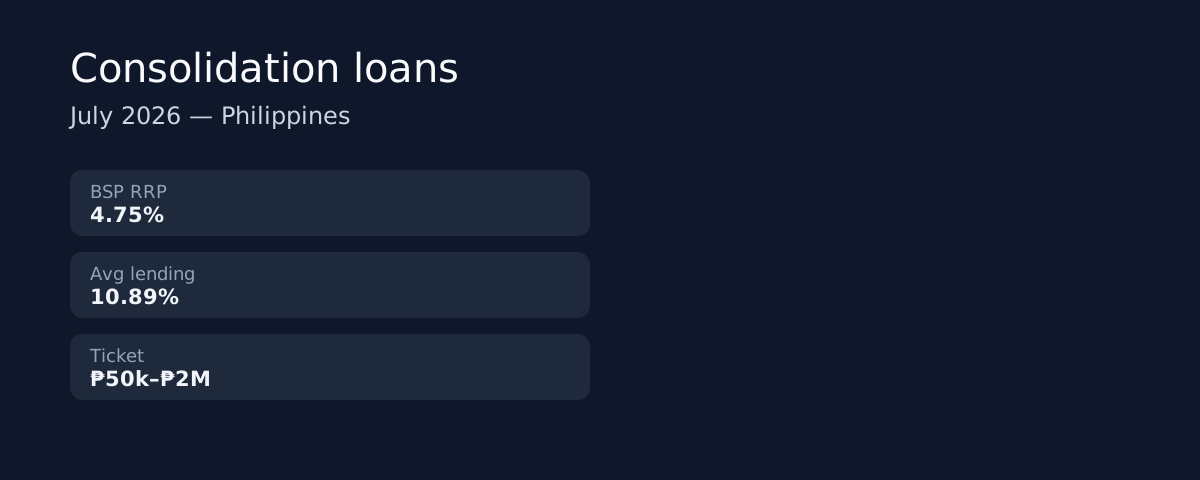
July 2026 check-in: merging card balances and personal loans into one BSP-supervised bank PL from BDO, BPI, Metrobank, Security Bank or Citibank still hinges on EIR, not monthly add-on alone. BSP's Target RRP is 4.75% in July 2026 while system average bank lending rate was 10.89% in late June 2026 — consolidation only wins when new EIR is materially below blended card revolve cost.
Typical tickets ₱50,000–₱2 million, tenures 12–60 months. Lender disburses to settle old creditors — keep closure letters; processing commonly 1–3% plus documentary stamps. Model peso savings after fees before signing.
| Benchmark | July 2026 | Use in compare |
|---|---|---|
| BSP Target RRP | 4.75% | Macro anchor |
| Avg bank lending | 10.89% | New PL reference |
| Card revolve | Often 24%+ EIR | Baseline to beat |
| Goal | Lower total ₱ outflow | Not just 1 EMI |
Parallel-quote two banks same tenor after listing all outstanding balances with penalties — skipping one expensive small ticket can erase consolidation benefit.