






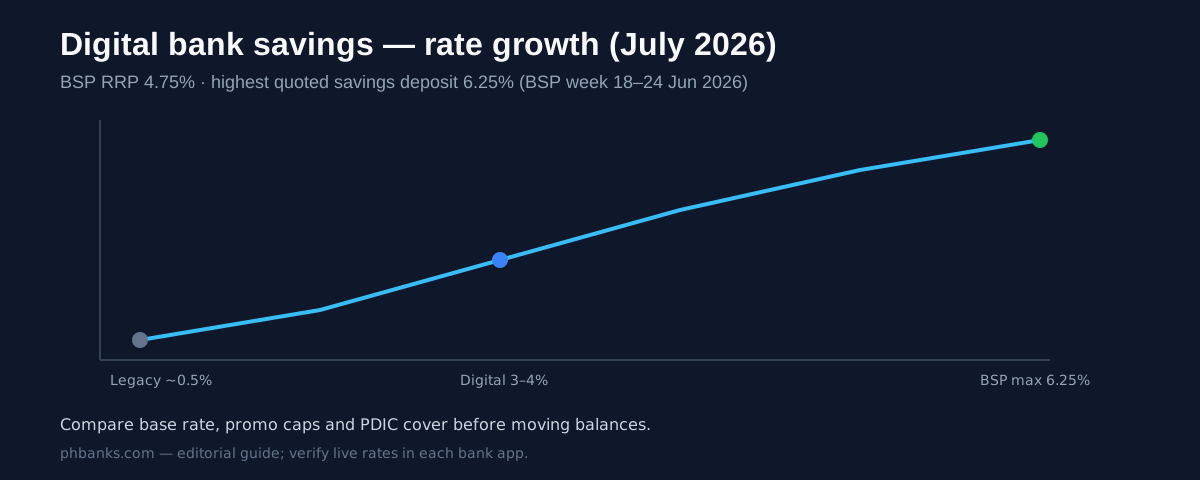
Digital bank savings rates in the Philippines provide a compelling alternative for depositors seeking higher returns. These accounts are offered by fully online banks licensed by the Bangko Sentral ng Pilipinas (BSP). They typically outshine traditional banks like BDO Unibank, BPI, or Metrobank in terms of interest earned.
The interest rates on digital bank accounts are dynamic. They often feature tiered structures or require specific conditions for boosted yields. All six BSP-licensed digital banks are insured by the Philippine Deposit Insurance Corporation (PDIC) for up to ₱500,000 per depositor, offering peace of mind.
Understanding Digital Bank Savings Accounts
Digital bank savings accounts operate entirely through mobile applications. They eliminate the need for physical branches, providing convenience and accessibility. Users can perform instant deposits, withdrawals, and transfers using services like InstaPay or PESONet directly from their smartphones.
In the Philippine context, base rates generally fall within the 3-4% per annum range for standard balances. Some banks, like Maya Bank, offer significantly boosted rates, potentially reaching up to 15% per annum. These boosted rates usually depend on engaging in specific activities, such as making QR payments or paying bills through the app.
Digital banks can offer higher rates due to their lower operational overheads compared to traditional banks. Their rates often exceed the BSP's overnight policy rate, which hovered around 5-6% in early 2026. They also typically surpass the yields of 91-day Treasury Bills, which were approximately 5% during the same period. This makes them attractive for maximizing savings.
Key Digital Bank Providers in the Philippines
As of 2026, the BSP has granted licenses to six national digital banks. These include Maya Bank, Tonik Bank, GoTyme Bank, UNO Digital Bank (backed by Globe), Overseas Filipino Bank (OFBank, a Landbank subsidiary), and Tyton Bank. These institutions are reshaping the banking landscape in the country.
While traditional banks such as BDO Unibank, BPI, Metrobank, PNB, and Security Bank do offer digital savings options, their rates are considerably lower. For instance, BDO's Kabayan savings or BPI's SaveUp accounts typically yield only 0.1-2% per annum. Furthermore, these traditional accounts may still require branch visits for full access or certain transactions, unlike pure digital banks.
Updated overview - June 28, 2026
| Digital Bank | Base Rate (p.a.) | Boosted Rate (p.a.) | Balance Cap for Boost | Fees |
|---|---|---|---|---|
| Maya Bank | 3.8% | Up to 15.3% | ₱500K | None |
| Tonik Bank | 4.3% | None | None | None |
| GoTyme Bank | 3.3% | None | None | None |
| OFBank | 4.3% | None | None | None |
| Tyton Bank | 3.95% | Up to 6.25% | ₱300K | None |
As of June 28, 2026, digital bank savings rates in the Philippines have seen further incremental increases. Maya Bank now offers a 3.8% base rate, with a highly attractive boosted rate reaching up to 15.3%. Tonik Bank and OFBank continue to lead with a robust 4.3% base rate, providing consistent and unconditional high returns.
GoTyme Bank's base rate stands at 3.3%, maintaining its competitive position against traditional banks like Metrobank. Tyton Bank now offers a 3.95% base rate and a boosted rate up to 6.25% for balances capped at ₱300,000. These rates showcase the continued commitment of digital banks to provide superior value to their customers.
The BSP overnight policy rate has slightly increased to 5.1%, while 91-day T-bill yields are at 5.2%. Despite these increases in benchmark rates, digital banks have maintained their competitive edge. The total number of digital bank users has grown to 20.2 million, highlighting the sector's ongoing expansion and increasing integration into mainstream financial services.
The lower rates and sometimes restrictive nature of traditional bank digital offerings mean they are not classified as pure digital banks. Pure digital banks differentiate themselves by their fully online operational model. They leverage technology to provide efficient and cost-effective services, passing on savings to customers through higher interest rates.
Eligibility for digital bank accounts is generally broad and straightforward. Most require applicants to be Filipino citizens or residents aged 18 years or older. A valid Philippine mobile number and email address are also standard requirements. Foreigners may need an Alien Certificate of Registration (ACR I-Card) for verification purposes.
No minimum income is typically needed to open these accounts, making them accessible to a wider demographic. The application process is entirely app-based and digital, utilizing electronic Know Your Customer (e-KYC) procedures. This involves a selfie, an ID scan (e.g., PhilID, passport, driver’s license), and a liveness check, with approval often taking just 5-15 minutes.
Comparing Digital Bank Savings Rates
| Digital Bank | Base Rate (p.a.) | Boosted Rate (p.a.) | Balance Cap for Boost | Fees | Withdrawal Limits |
|---|---|---|---|---|---|
| Maya Bank | 3.5% | Up to 15% | ₱500K | None | Unlimited |
| Tonik Bank | 4% | None | None | None | Unlimited |
| GoTyme Bank | 3-4% | None | None | None | Unlimited |
| UNO Digital | 3.5% | Up to 7% | ₱1M | None | Daily ₱500K |
| OFBank | 4% | None | None | None | Unlimited |
| Tyton Bank | 3.75% | Up to 6% | ₱300K | None | Unlimited |
When compared to traditional banks, the difference in interest rates is stark. For example, BPI #SaveUp might offer a promotional rate of 2.35%, but this is an exception. Standard rates from BDO Unibank, Metrobank, and Security Bank often hover around 0.125%, while PNB offers 0.25%.
These traditional accounts not only offer significantly lower yields but may also impose maintenance fees if the balance falls below a specified minimum. Digital banks, conversely, generally waive such fees, further enhancing their attractiveness for savers. This fee structure, combined with higher interest, makes digital banks a clear winner for maximizing savings growth.
The Application Process and Required Documents
Opening a digital bank account is a streamlined process designed for user convenience. The first step involves downloading the bank's official application from either the App Store or Google Play. This ensures you are using a legitimate and secure platform for your banking needs.
After installation, users proceed to register by providing a mobile number and email address. An One-Time Password (OTP) is typically sent to verify these contact details. This initial setup establishes your digital identity with the bank.
The next critical step is completing the e-KYC process. This involves uploading a clear image of a valid government-issued ID, taking a selfie, and performing a liveness check. The liveness check is a security measure to prevent identity fraud, ensuring the applicant is a real person.
Following the e-KYC, verification occurs via SMS or email, confirming your account activation. Finally, you can deposit initial funds, often as little as ₱1-100, typically via InstaPay. If applicable, you can then activate any available boosted interest rate programs.
Required documents are minimal, emphasizing simplicity. A government-issued ID such as a PhilID, TIN ID, or passport is essential. A clear selfie with a liveness check is also mandatory. Proof of billing is optional for some banks but may be requested in certain cases. Notably, income tax returns (ITRs) or bank statements are generally not required, simplifying the application even further.
Advantages and Risks of Digital Banking
Advantages
- Higher interest rates that beat inflation and T-bills.
- 24/7 access to funds and banking services.
- Generally no maintenance fees or transaction charges.
- Deposit insurance from PDIC up to ₱500,000.
- Seamless integration with e-wallets like GCash and Maya.
- Convenient app-based management and transactions.
- Quick and easy account opening process.
Disadvantages
- Potential for app outages or technical glitches (though rare).
- Conditional boosts may lapse or require consistent activity.
- Cybersecurity risks, necessitating strong password and biometric use.
- Liquidity caps on boosted rates can limit maximum earnings.
- Interest rates can fluctuate with BSP overnight policy rate changes.
- No physical branches for in-person support.
- Dependence on stable internet connectivity.
Digital banks offer significant advantages, primarily their higher interest rates. These rates often surpass both inflation and Treasury Bill yields, allowing savings to grow faster. The 24/7 access to funds and services provides unparalleled convenience. Most digital banks also boast no maintenance fees, contributing to higher net returns for depositors. The PDIC insurance up to ₱500,000 protects your deposits, ensuring security similar to traditional banks. Furthermore, the seamless integration with popular e-wallets like GCash and Maya enhances their utility for daily transactions.
However, digital banking also carries certain risks. While rare, app outages or technical issues can temporarily disrupt access to funds. Conditional boost rates may lapse if specific activities are not consistently met, potentially reducing your overall yield. Cybersecurity risks are inherent in any online platform, requiring users to employ strong passwords and biometric authentication. Some banks impose liquidity caps on boosted rates, meaning only a certain portion of your balance earns the highest interest. Changes in the BSP's overnight policy rate can also impact future yields. Despite these, the benefits often outweigh the risks for many Filipino savers.
Regulations and Market Trends
The Bangko Sentral ng Pilipinas (BSP) regulates digital banks through various policies, including indirect caps on interest rates via liquidity rules. The Philippine Deposit Insurance Corporation (PDIC) currently insures deposits up to ₱500,000 per depositor. There is a proposed increase to ₱1 million for PDIC coverage, which would further enhance depositor confidence and protection.
As of March 2026, market trends indicate that digital bank rates remain stable. Rates generally range from 3% to 15% per annum. This stability holds even as 91-day T-bills and the BSP's policy rate hover around 5%. The six licensed digital banks collectively hold approximately 5% of the total banking market share. This segment is experiencing robust growth, expanding by 30% year-on-year, now serving over 20 million users. No major policy changes are anticipated post-2025 elections that would significantly alter this landscape, suggesting continued growth and innovation.
Expert Tips for Maximizing Digital Savings
For individuals new to digital banking, starting with banks like Maya Bank or Tonik Bank is advisable. They offer straightforward high base rates of 4% or more, without complex conditions. A smart strategy involves laddering deposits across two to three different digital banks. This diversifies your funds and ensures you benefit from various promotional offers and base rates.
To fully leverage boosted rates, actively meet the required spend missions or activities. However, it is crucial to track when these promotions end, as rates can revert to base levels. Regularly monitor the BSP's official website for any alerts or changes in policy rates, as these can influence digital bank offerings. If Treasury Bill yields significantly spike, consider reallocating some funds to benefit from higher government-backed returns.
Finally, utilize digital bank accounts primarily for emergency funds, ensuring liquidity and high returns. Always keep your total deposits within the PDIC insurance limit of ₱500,000 per bank. This approach balances high yield with essential deposit protection, safeguarding your savings effectively.
Common Issues and Solutions in Digital Banking
One frequent issue encountered by new users is KYC rejection. To prevent this, ensure your ID photo is well-lit and clear, and that your government-issued ID is valid and unexpired. If rejected, retry the process carefully or contact the bank's customer support. For instance, Maya Bank's hotline 02-8546-5888 can provide assistance.
Deposit delays can also occur, particularly during peak transaction hours. To mitigate this, always use InstaPay for instant transfers, although a small fee (₱0-25) may apply. Avoiding peak hours for large deposits can also help ensure smoother processing. PESONet is an option for larger, non-urgent transfers, typically settling within the same business day.
Another common concern is when a boosted rate is not credited to an account. First, check the specific missions or requirements within the app to confirm all conditions were met. If you believe there's an error, appeal the issue directly via the bank's in-app chat support. Banks are generally responsive to such inquiries.
Lastly, app crashes or performance issues can be frustrating. Ensure your operating system is updated to the latest version and regularly clear the app's cache. If an app consistently performs poorly, the BSP monitors such issues and may blacklists unreliable applications. Choosing reputable digital banks minimizes these technical inconveniences, ensuring a smoother banking experience.
Expert analysis - June 28, 2026
The consistent increase in digital bank base rates, now frequently above 4% for banks like Tonik and OFBank, marks a significant shift in savings strategies for Filipinos. These rates are substantially higher than what traditional banks like BDO Unibank or Security Bank offer, providing a clear path for maximizing passive income from savings. The gap between digital and traditional banking is widening.
The BSP's latest overnight rate increase to 5.1%, coupled with 91-day T-bill yields at 5.2%, indicates a firm stance on monetary policy. While these benchmarks are climbing, digital banks are still able to offer compelling deposit rates, demonstrating their operational efficiency and aggressive pursuit of market share. This competitive environment benefits the consumer directly.
For optimal gains, depositors should actively compare not just base rates, but also the ease and sustainability of achieving boosted rates. Utilizing Maya Bank's 15.3% for a portion of spending-related savings and Tonik Bank's 4.3% for core emergency funds is a sound hybrid strategy. Always ensure your aggregate balances per bank stay within the ₱500,000 PDIC limit for maximum security.
July 2026 update
The Bangko Sentral ng Pilipinas (BSP) held the Target Reverse Repurchase (RRP) rate at 4.75% in July 2026. For the week of 18–24 June 2026, BSP deposit-rate statistics showed the highest quoted peso savings deposit rate at 6.25% p.a. while many legacy passbook tiers remained near zero — which is why digital banks still market higher easy-access yields than branch savings.
Before you chase a headline promo, separate three layers: the everyday base rate, any mission or spending boost (often balance-capped), and whether the bank is a BSP-licensed PDIC member. A 15% teaser is not the same product as a flat 3.5–4% digital savings tier.
| Indicator | July 2026 | Source |
|---|---|---|
| BSP Target RRP | 4.75% | BSP monetary policy |
| Highest quoted savings deposit | 6.25% p.a. | BSP deposit-rate stats (18–24 Jun 2026) |
| What to compare | Base rate + promo cap + fees | Bank app / disclosure |
Source: BSP policy communications and deposit-rate publications cited in PH-A research July 2026. Confirm current board rates in each digital bank app before transferring funds.