





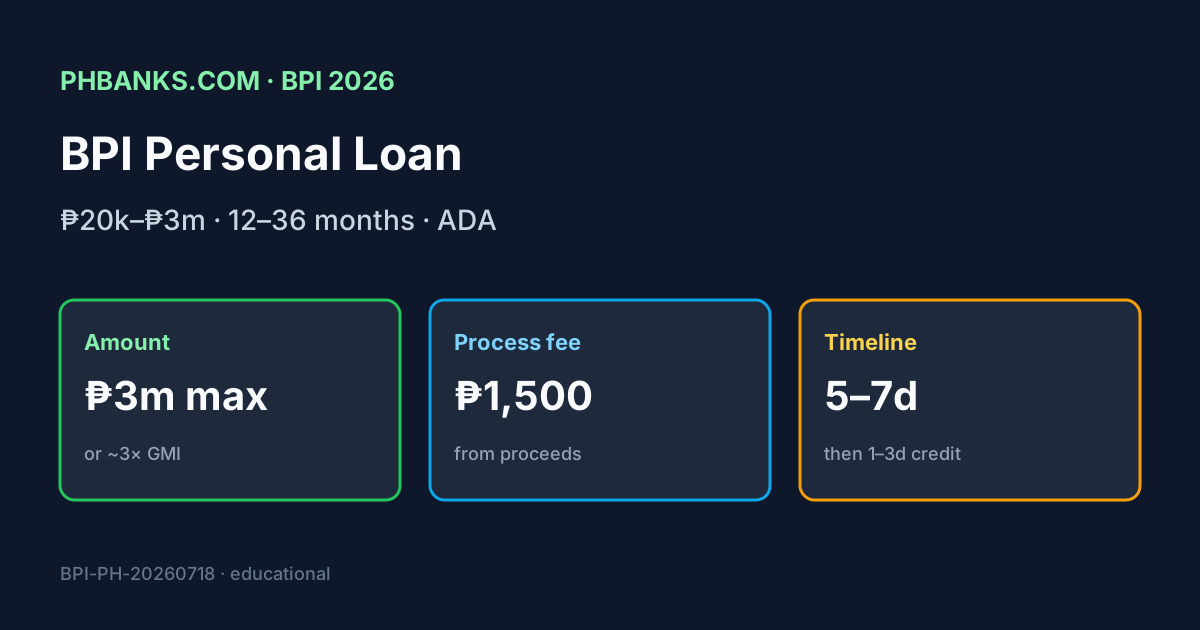
The BPI Personal Loan stands as a prominent unsecured financing product in the Philippines. It originates from the Bank of the Philippine Islands (BPI), a major player in the nation's banking sector. This loan is specifically crafted for Filipinos seeking quick capital for various needs. These needs often include home renovations, educational expenses, travel plans, or debt consolidation.
The loan functions by providing a single lump-sum amount upon approval. Borrowers can receive up to ₱3 million, or often three times their monthly income. This amount is disbursed directly into their BPI account. Repayment occurs through fixed monthly installments over a period ranging from 12 to 60 months. The loan features a competitive add-on interest rate of approximately 1.20% monthly.
This monthly add-on rate translates to an Effective Interest Rate (EIR) of about 25-28% annually. The specific EIR is influenced by several factors. These include prevailing BSP overnight rates and T-bill yields, which hovered around 5-6% in early 2026. BPI manages all aspects of this product directly. This includes applications, processing, and servicing, exclusively through its own channels.
BPI Personal Loan: Product Overview and Exclusivity
The "BPI Personal Loan" is a proprietary product offered solely by BPI. No other banks, such as BDO Unibank, Metrobank, PNB, or Security Bank, provide a loan under this exact name. These other financial institutions offer their own distinct personal loan products. Examples include the BDO Personal Loan, Metrobank Multi-Purpose Loan, PNB Personal Loan, and Security Bank Personal Loan.
BPI operates as a universal bank with an extensive network across the Philippines. It boasts over 1,170 branches nationwide. This broad reach ensures accessibility for many potential borrowers. The bank’s internal systems handle all application processing. This guarantees that the BPI Personal Loan experience is consistently managed by BPI itself.
Eligibility Criteria and Required Documentation
To qualify for a BPI Personal Loan, applicants must meet specific criteria. They must be at least 21 years old. Applicants must also be Filipino citizens or resident aliens. Stable income is a key requirement, whether from employment (salaried or self-employed) or professional practice. A gross monthly income of at least ₱20,000 is typically needed. The minimum loan amount is ₱20,000.
Key requirements for documentation include valid government-issued identification. Examples are an SSS/UMID ID, passport, or driver's license. Employed applicants need their latest three months' payslips or BIR Form 2316/ITR. A Certificate of Employment (COE) is also necessary. Self-employed individuals must provide DTI/SEC registration, audited financial statements, and ITRs.
Upon approval, a BPI account is mandatory for loan disbursement. BPI assesses an applicant's credit score and debt-to-income ratio. The ideal debt-to-income ratio is under 40%. These assessments are conducted through BPI's internal checks. They are linked to the Credit Information Corporation (CIC), which tracks borrower credit histories.
Updated overview - April 28, 2026
| Provider | Max Amount | Term (months) | Monthly Add-On Rate | EIR (Annual) | Processing Fee |
|---|---|---|---|---|---|
| BPI | ₱3M | 12-60 | 1.28% | 27-30% | ₱1,500 |
| BDO Unibank | ₱2M | 6-36 | 1.33-1.58% | 28-32% | 1% (min ₱2,000) |
| Metrobank | ₱1M | 12-48 | 1.38% | 29% | 1% |
| PNB | ₱5M | 12-60 | 1.23-1.48% | 26-31% | ₱1,000 + 1% |
| Security Bank | ₱2.5M | 12-36 | 1.26% | 27% | 1% (min ₱2,500) |
As of April 28, 2026, personal loan rates have resumed an upward trajectory across the board. The BSP overnight rate has increased to 6.0%, signaling a tighter monetary policy. T-bill yields have also climbed to 6.1%, impacting bank funding costs.
BPI's monthly add-on rate is now 1.28%, pushing its EIR to 27-30%. This adjustment reflects the broader market movement. Other major banks, including BDO Unibank, Metrobank, PNB, and Security Bank, have also implemented similar rate increases.
The general trend indicates higher borrowing costs for consumers in the short to medium term. The inflation rate has also slightly risen to 3.6%. Borrowers should carefully reassess their repayment capacity with these new rates.
Interest Rates and Market Comparison
BPI's advertised add-on rate is approximately 1.20% monthly. This translates to an Annual Effective Interest Rate (EIR) of 25.03-28.67%. The EIR varies based on the loan term chosen. For instance, a 12-month term might have an EIR of 25.6%, while a 60-month term could be 25.03%. A processing fee of ₱1,500 applies, or 1% of the loan amount if higher.
Loan terms for BPI range from 12 to 60 months. When comparing with other major banks, prevailing rates in 2026 were influenced by the BSP's policy rate, which was around 5.5%, and T-bill yields at 5.75%. The comparison below outlines various offerings from key Philippine banks.
BPI distinguishes itself with longer repayment terms and higher loan limits. However, its interest rates fall within the mid-range compared to its competitors. Prospective borrowers are advised to check comparison portals like Moneymax for potential promotional rates. This can help secure more favorable terms.
| Provider | Max Amount | Term (months) | Monthly Add-On Rate | EIR (Annual) | Processing Fee |
|---|---|---|---|---|---|
| BPI | ₱3M | 12-60 | 1.20% | 25-28% | ₱1,500 |
| BDO Unibank | ₱2M | 6-36 | 1.25-1.50% | 26-30% | 1% (min ₱2,000) |
| Metrobank | ₱1M | 12-48 | 1.30% | 27% | 1% |
| PNB | ₱5M | 12-60 | 1.15-1.40% | 24-29% | ₱1,000 + 1% |
| Security Bank | ₱2.5M | 12-36 | 1.18% | 25% | 1% (min ₱2,500) |
Application Process and Required Documents
The application process for a BPI Personal Loan begins with checking eligibility. Utilize BPI's online loan calculator at bpi.com.ph. Input your desired loan amount and term to estimate your monthly amortization. This helps in financial planning before formal application.
Next, gather all necessary documents and download the application form from BPI's website. You can submit your application online via the BPI website or mobile app. Alternatively, send it via email to personal.loans@bpi.com.ph. In-branch submission is also an option for those who prefer face-to-face interaction.
Expect a credit evaluation period of 5-7 banking days. If shortlisted, you will need to provide your BPI account details for fund disbursement. Upon receiving an approval notice, sign the loan agreement. This can be done digitally or at a BPI branch. Finally, funds are disbursed to your account, and auto-debit can be set up for convenient monthly payments.
Required documents are critical for a smooth application. For employed individuals, proof of income includes three months of payslips, a Certificate of Employment (COE), or BIR Form 2316. Self-employed applicants need two years of ITR (1601F/1701), business registration documents (DTI/SEC/BIR), and bank statements.
Primary identification requires any two government-issued IDs with a photo and signature. A completed application form is always necessary. Post-approval, a voided check or proof of your BPI account is required. Digital scans are usually sufficient for online applications, but original documents might be requested for verification during in-branch processes.
Advantages and Risks of BPI Personal Loan
Advantages
- No collateral is required for approval.
- Quick approval process for eligible applicants.
- Flexible use of funds for various needs.
- Competitive rates compared to credit cards (often 3%+ monthly).
- Easy payments through BPI network and GCash links.
- Builds positive credit history with timely repayments.
Disadvantages
- High Effective Interest Rate (EIR) can significantly increase total cost.
- Penalties for late payments include 5% of due amount plus 1% per month.
- Risk of debt trap if borrowing exceeds repayment capacity, especially during inflation.
- No early payment rebate on add-on interest loans.
- BSP overnight rate hikes can push up loan costs.
The BPI Personal Loan offers several advantages. It requires no collateral, providing an accessible option for many. The approval process is relatively quick, allowing borrowers to access funds promptly. Funds can be used flexibly for various purposes, from home improvements to medical emergencies. Its interest rates are generally more competitive than typical credit card rates, which often exceed 3% monthly. Repayment is made easy through BPI's extensive network and integration with platforms like GCash. Consistently making on-time payments can also help build a positive credit history.
However, potential risks must be considered. The high Effective Interest Rate (EIR) can considerably increase the overall cost of the loan. For example, a ₱1 million loan over 36 months could accrue approximately ₱350,000 in total interest. Late payments incur penalties, typically 5% of the overdue amount plus an additional 1% per month. There is also a risk of falling into a debt trap if individuals overborrow, particularly amidst inflationary pressures, which were around 3-4% in 2026. A notable drawback is the absence of an early payment rebate on add-on interest loans.
Borrowers should only take what they genuinely need. It is crucial to factor in potential increases in loan costs due to BSP overnight rate hikes, which recently stood at 5.75%. While the Philippine Deposit Insurance Corporation (PDIC) covers deposits up to ₱500,000, it does not insure loans; the repayment risk lies solely with the borrower.
Regulations, Trends, and Expert Advice
The Bangko Sentral ng Pilipinas (BSP) regulates personal loans through circulars like Circular 1105. This circular sets a maximum EIR cap of 36%. BPI's EIR, typically under 30%, complies with these regulations. The PDIC ensures BPI deposits, but personal loans are not covered. This means borrowers bear full responsibility for repayment.
Trends in 2026 show rising T-bill rates, around 5.8%, and a BSP policy rate of 5.5%. These factors have caused personal loan EIRs to increase by 1-2% year-on-year. Digital applications for personal loans surged by 40% post-pandemic. Fintech companies are increasingly challenging traditional banks. However, BPI maintains a strong position in the retail banking sector. Promotional rates are often offered to lower-risk borrowers.
Expert tips can optimize your loan experience. Always use BPI's calculator first to estimate monthly amortization. Aim for an amortization amount that is less than 40% of your gross income. Improve your approval odds by settling existing debts and maintaining a CIC score of 700 or higher. Compare offers using financial aggregators like Moneymax.ph. If you are an existing BPI client, you might be able to negotiate better rates.
Timing your application can also be strategic. Apply shortly after your salary cycle to show strong cash flow. Avoid applying during periods of anticipated BSP rate hikes. Opting for shorter loan terms generally minimizes the total interest paid. However, ensure the monthly payments align with your cash flow capacity.
Common Issues and Solutions
Loan rejection is a common issue, often due to a poor credit score or insufficient income. To address this, regularly check and fix any inaccuracies on your CIC report via cic.com.ph. Consider adding a co-borrower to strengthen your application. Alternatively, apply for a smaller loan amount that aligns with your current financial standing. If processing delays occur, ensure all documents are submitted completely on Day 1. Follow up proactively via BPI's hotline at (02) 89000.
Disputes over high fees are another concern. Always confirm all charges and fees before signing any loan agreement. For unresolved complaints, contact the BSP Consumer Assistance at (02) 8708-7087. If facing over-indebtedness, debt consolidation can be a solution. However, only pursue it if the new loan's EIR is lower than your existing debts. The Department of Finance (DOF) also offers debt relief programs that might provide assistance.
For eligible members, Philippine-specific alternatives like SSS or GSIS salary loans can be more affordable. These often come with lower monthly interest rates, sometimes as low as 1%. These options are particularly beneficial for government employees and private sector workers who are SSS members. Always explore all available financing avenues suitable for your financial situation.
Expert analysis - April 28, 2026
The renewed increase in the BSP overnight rate to 6.0% signals the central bank's continued focus on managing inflation. This directly translates to higher lending rates for personal loans. Borrowers who delayed their applications might find themselves facing higher costs.
All major banks have adjusted their rates upwards, maintaining competitive positioning relative to each other. BPI's increase to 1.28% monthly add-on rate is in line with these market dynamics. This emphasizes the need for quick decision-making when rates appear stable.
The slightly higher inflation rate of 3.6% further underscores the importance of efficient financial planning. While personal loans offer flexibility, the rising cost of borrowing means thorough calculation of total repayment is more critical than ever. Prioritize essential borrowing.