






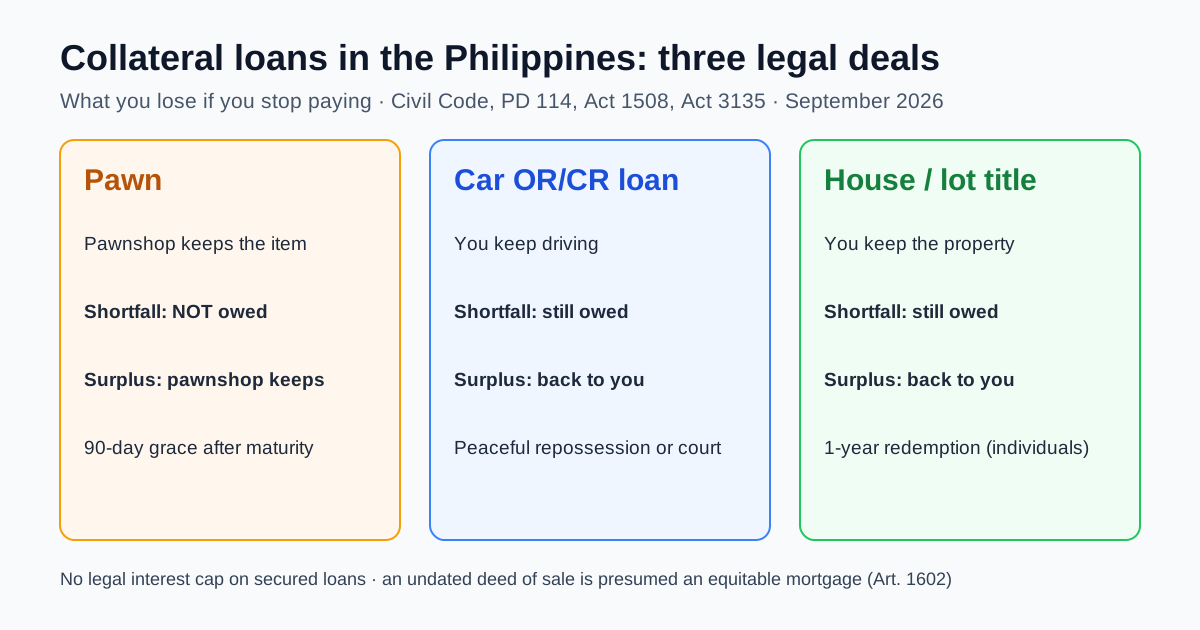

COLLATERAL-PH-20260927A collateral loan in the Philippines is one of three legally different deals, and the law behind each one decides what you lose if you stop paying. Pawn your gold, and a missed redemption costs you the item. The debt ends there, but the pawnshop keeps whatever the auction brings above the loan. Borrow against your car's OR/CR, and you keep driving, but after a foreclosure sale the lender can still sue you for any shortfall. Mortgage a titled house or lot, and you get up to a year to redeem it after a foreclosure sale. Any surplus from that sale comes back to you, and any shortfall stays your debt.
No law caps the interest on any of these three. The SEC ceilings of 2022 cover only small unsecured loans of up to ₱10,000 over four months. Pawnshops set their own rates: Palawan Pawnshop advertises as low as 2.5% a month on its advance-interest package, which is about 30% a year before renewals. What protects you is a set of procedural rules, and knowing them matters more than comparing rates.
Three deals side by side
| Point of comparison | Pawn (pledge) | Car OR/CR loan (chattel mortgage) | House or lot loan (real estate mortgage) |
|---|---|---|---|
| Who holds the asset | Pawnshop keeps the item | You keep the car; lender holds the OR/CR and a registered mortgage | You keep the property; mortgage annotated on the title |
| Main law | Pawnshop Regulation Act (PD 114); Civil Code Art. 2115 | Chattel Mortgage Law (Act 1508) | Act 3135; General Banking Law Sec. 47 for banks |
| Supervisor | Bangko Sentral ng Pilipinas | BSP for banks, SEC for financing and lending companies | BSP for banks, SEC for lending companies |
| If you default | Item auctioned after the 90-day grace period | Car repossessed peacefully or through a court order, then sold | Extrajudicial foreclosure auction after posting and publication |
| Shortfall after the sale | Cannot be collected from you | Can be collected from you | Can be collected from you |
| Surplus after the sale | Stays with the pawnshop unless the ticket says otherwise | Returned to you | Returned to you |
The shortfall and surplus rows explain why a pawn feels harmless and is not. If a ring worth ₱40,000 secures a ₱20,000 loan and you let it lapse, the debt is gone, but so is ₱20,000 of value that the pawnshop keeps. With a car or a house, the danger runs the other way. The asset can go and the debt can survive it.
Pawn: cheap to open, expensive to keep renewing
PD 114 and BSP rules fix the paperwork, not the price. The service charge is 1% of the principal but may not exceed ₱5, and no other charges are allowed. A pawnshop may not collect advance interest for more than one year. The pawn ticket must show the appraised value, the effective interest rate, the maturity date and the expiry of the redemption period. After maturity, usually 30 days, you have 90 days to redeem. Before an auction, the pawnshop must publish a notice in two newspapers at least six days ahead, or post notices at the town hall where no local paper circulates.

The real cost is renewal. Paying only the interest, or tubo, rolls the ticket over and restarts the clock, but the principal never moves. On a ₱20,000 gold pawn:
| Kept alive by paying interest only | At 3% a month | At 3.5% a month |
|---|---|---|
| 1 month | ₱600 | ₱700 |
| 3 months | ₱1,800 | ₱2,100 |
| 6 months | ₱3,600 | ₱4,200 |
| 12 months | ₱7,200 | ₱8,400 |
A year of renewals costs 36% to 42% of the loan and leaves you owing the same ₱20,000. Most pawnshops accept partial payment, or hulog, on top of the interest. Every peso of principal you pay lowers next month's charge, so pay down whenever you can. Palawan's own packages show that the pricing is negotiable. Its no-advance package is 3.5% a month and its advance-interest package 2.5%. Its Lipat Sangla offer targets gold already pawned elsewhere, so moving a long-running pawn to a cheaper shop is a legitimate option.
Car OR/CR loans: you keep driving, the debt follows you
When you borrow against a car you already own, the lender takes a chattel mortgage. To bind anyone beyond the two of you, it must be in writing, registered in the chattel mortgage registry of the Registry of Deeds and annotated on the certificate of registration at the LTO. Banks offer these as cash loans. Security Bank's Car4Cash, for example, lends up to ₱2,000,000 against the OR/CR while you keep using the car.
Many borrowers think the Recto Law will protect them, and for this kind of loan it does not. Civil Code Art. 1484 bars a deficiency claim only when a car was bought on installment and the seller or its financing assignee forecloses. A cash loan on a car you already own is an ordinary loan, so the lender may foreclose, sell the car and sue for the rest. Repossession must be peaceful. Agents need the lender's written authority. If you refuse to hand over the car, the lender cannot use force and must go to court for a writ of replevin. Taking a vehicle by threat or stealth exposes the agents to criminal charges.
The informal version works differently. In a "sangla" where you leave the car in the lender's garage, the deal is a pledge, and the no-deficiency rule of Art. 2115 applies. If you are buying a car rather than borrowing against one, our car loan guide for the Philippines covers installment financing, where the Recto Law does apply.
Title-backed loans: the longest protection, the strictest paperwork
A real estate mortgage gives you the most time. Under Act 3135, the notice of sale must be posted for at least 20 days in three public places and published once a week for three consecutive weeks in a newspaper of general circulation. After the auction, an individual borrower may redeem for one year. That year counts from the registration of the certificate of sale with the Registry of Deeds, not from the auction day. When the lender is a bank, the redemption price is set by the General Banking Law. It is the amount due under the mortgage, with interest at the contract rate and the bank's costs, less any income the bank drew from the property. A corporate borrower gets far less time: only until the certificate of sale is registered, and never more than three months after the foreclosure.
Banks lend only a fraction of appraised value against property you already own. HSBC, for instance, caps multi-purpose top-up loans at 60% of property value, against 80% for a purchase. Most rejections come from the title rather than the borrower:
- Tax declaration only. Commercial banks require a Torrens title (OCT, TCT or CCT). Only rural and cooperative banks may lend against untitled land, and only under specific conditions.
- Mother title. A lot inside an unsubdivided tract cannot be mortgaged until it has its own TCT in your name.
- Co-owned property. Banks want every co-owner to sign, or a partition first.
- Conjugal or community property. A mortgage without the written consent of the other spouse is void under the Family Code, even when the title shows one name.
- Title still in a deceased parent's name. The estate must be settled and the title transferred before heirs can borrow on it.
- Annotations. A lis pendens, an adverse claim, a levy or agrarian reform restrictions stop the loan.
If the property you are pledging is one you are still paying for, read our guide to home loans in the Philippines first. Its repricing and prepayment rules decide how much equity you actually have to borrow against.
The deed-of-sale trap
The most expensive mistake in Philippine collateral lending happens at signing. Informal lenders, especially in sangla-tira or sangla-titulo deals, ask the borrower to sign an undated deed of absolute sale or a sale with right to repurchase (pacto de retro), "just as security". The plan is to date it after one missed payment and take the car or land without foreclosing.
The Civil Code is on the borrower's side, and knowing that changes how you negotiate. Art. 2088 voids any clause that lets a creditor appropriate or dispose of pledged or mortgaged property on its own. Arts. 1602 and 1604 presume that a "sale" is really an equitable mortgage in several situations: the price is unusually low, the seller stays in possession, the seller keeps paying the taxes, or the real purpose was to secure a debt. Under Art. 1605, the borrower can ask a court to reform the document into a mortgage. The lender must then foreclose through the normal process, redemption rights included. Still, do not sign an undated deed of sale for any loan. Winning a reformation case takes years. Refusing to sign takes a minute.
Check the lender before you hand over anything
A lending or financing company needs an SEC Certificate of Authority, not just an SEC certificate of incorporation. Under the Lending Company Regulation Act, operating without one is illegal. Ads and apps must show both the SEC registration number and the CA number, and the SEC publishes its list of authorized companies and recorded online lending platforms. Our overview of loan apps in the Philippines shows how to read those numbers. Pawnshops are supervised by the BSP and must display their authority to operate.
Because secured loans have no interest cap, the courts are the backstop. The Supreme Court has repeatedly cut rates it found unconscionable. The best-known case is Medel v. Court of Appeals (1998), which struck down 5.5% a month. For a dispute, complain to the institution first. Then escalate to the BSP Consumer Assistance Mechanism for banks and pawnshops, or to the SEC for lending and financing companies. The Financial Products and Services Consumer Protection Act of 2022 (RA 11765) bans abusive collection and gives both regulators power to order refunds. Money claims of up to ₱1,000,000 can go to small claims court without a lawyer.
Matching the collateral to the need
Pawning suits a small amount needed for weeks, not months: redeem within one or two renewals, or pay hulog each month. An OR/CR loan from a bank suits a car owner who needs a six-figure sum over a few years and has a steady income to carry it, since the shortfall risk is real. A title loan is for large amounts and long terms, and only when the title is clean and every co-owner and spouse will sign. If your savings sit in a time deposit, a deposit-secured, or hold-out, loan from the same bank is usually the cheapest money of all. The bank already holds the collateral and prices the loan only a few points above what the deposit earns. For a general comparison of secured and unsecured borrowing, see our page on secured loans.