





Citibank Personal Loan in the Philippines offers a direct and efficient financial solution. It provides unsecured funds for various personal needs. This product is offered directly by Citibank N.A. Philippine Branch. Individuals can access quick cash for different purposes.
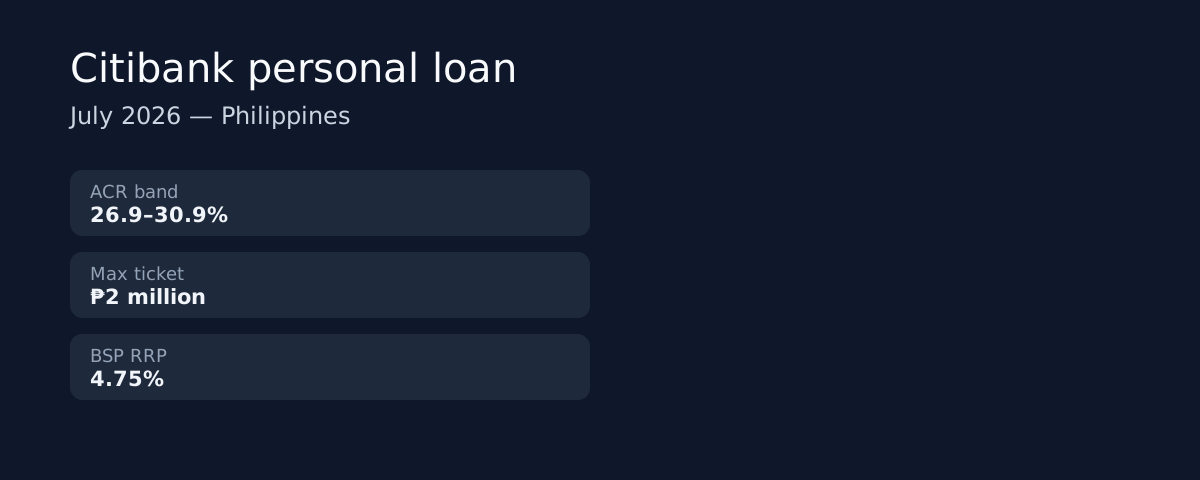
The loan amounts range from ₱20,000 up to ₱2 million. Common uses include debt consolidation, emergency expenses, or funding major purchases. Repayment terms are flexible, extending from 12 to 60 months. Crucially, no collateral is required, simplifying the application process for many.
The loan process involves disbursing funds directly to your account. This often happens within 24 hours of approval. Fixed monthly installments are then deducted automatically. Auto-debit arrangements can be set up from your Citibank account or a linked bank account.
Effective interest rates for Citibank Personal Loans typically range from 26.9% to 30.9% Annual Credit Rate (ACR). These rates are influenced by several economic factors. Key among these are the Bangko Sentral ng Pilipinas (BSP) overnight rates. As of early 2026, these rates hover around 5-6%. Treasury bill yields also play a role, usually around 4-5%.
Understanding Citibank Personal Loans in the Philippines
Citibank Personal Loans are exclusively offered by Citibank itself within the Philippines. They are not available through other local banks. This means you cannot apply for a Citibank loan at BDO Unibank, BPI, Metrobank, PNB, or Security Bank. These other institutions have their own distinct personal loan products.
For example, BDO offers personal loans up to ₱2 million. Their monthly add-on rate is approximately 0.9%. However, these are BDO's products, not Citibank's. No other bank partners with or distributes Citibank loans. This exclusivity simplifies the channel for applicants.
The eligibility criteria for a Citibank Personal Loan are straightforward. Applicants must be between 21 and 65 years old. They must be Filipino citizens or resident foreigners. Employment status is also a key factor. Salaried individuals need a minimum monthly income of ₱25,000. Self-employed individuals require a minimum monthly income of ₱40,000.
Applicants must also have at least one year of tenure in their current employment or business. Maintaining a good credit score is essential for approval. Existing Citibank customers might qualify for better rates or more favorable terms. This provides an incentive for loyal clients.

BSP 4.75% context — August 2026
BSP Target RRP 4.75% July 2026 anchors policy — does not cap Citibank ACR; shop mass-market bank if EIR exceeds 20% on clean bureau file.
Citibank PL is exclusive to Citibank — not sold via BDO/BPI counters; apply direct branch or official digital channel only.
| Anchor | Channel | Rule | RRP |
|---|---|---|---|
| 4.75% | Macro | Citibank | Direct only |
| No partners | EIR | 20%+ | Shop banks |
Confirm BSP-supervised lender status and disclosure-statement EIR before signing — policy-rate moves reprice new originations, not always existing fixed-rate blocks.
Citibank Personal Loan Application Process
Applying for a Citibank Personal Loan is designed to be user-friendly. You can start by visiting citibank.ph/personal-loans. Alternatively, you can call their hotline at 02-8899-5000. These channels allow you to check your initial eligibility through an online pre-qualifier.
After pre-qualification, you will submit an online form. This form requires personal and financial details. You will also need to upload scanned copies of required documents. This digital submission streamlines the initial steps of the application. The system guides you through each necessary field.
You can expect to receive conditional approval within 24 to 48 hours. Once approved, you will sign documents digitally. Funds are typically disbursed within 3 to 5 days, deposited directly into your designated account. This fast turnaround is a key advantage for urgent financial needs.
Upon receiving the funds, you will set up your auto-debit arrangements. You can also track your loan status and payments easily. The Citi Mobile App provides a convenient platform for monitoring your account. This digital access enhances transparency and control over your loan.
Required Documents for Application
To apply for a Citibank Personal Loan, several documents are necessary. You will need two valid IDs, such as a passport or driver's license. These establish your identity. Ensure both IDs are government-issued and up-to-date.
Proof of income is also crucial. Salaried individuals can provide their latest three payslips, a Certificate of Employment (COE), or an Income Tax Return (ITR)/BIR Form 2316. Self-employed individuals need to submit audited financial statements and business registration documents. These documents verify your capacity to repay the loan.
Additional requirements include bank statements for the last 3-6 months. Your Tax Identification Number (TIN) is also needed. If applicable, proof of your existing Citibank account should be provided. These documents help Citibank assess your financial standing comprehensively.
The standard procedure involves emailing or uploading these documents to personal.loans@citi.com. After conditional approval, original documents may be requested for verification. This ensures the authenticity of the information provided. Always double-check that all submitted documents are clear and complete to avoid delays.
Advantages and Risks of Citibank Personal Loans
Citibank Personal Loans offer several distinct advantages. They boast fast approval times, often within 24 hours. The loan limits are relatively high, extending up to ₱2 million. Flexible repayment terms are also available, from 12 to 60 months. Moreover, the loans are unsecured, meaning no collateral is required. This makes them ideal for urgent financial needs, especially with current high BSP rates.

However, potential risks also exist. The effective interest rates can be high, often around 30% or more, contributing to a significant total cost. Penalties apply for late payments, typically 5% of the overdue amount. There is also a risk of falling into a debt trap if overborrowed. As an unsecured loan, defaulting can severely impact your credit score.
Advantages
- Fast approval (often 24 hours)
- High loan limits (up to ₱2 million)
- Flexible repayment terms (12-60 months)
- No collateral required
- Suitable for urgent financial needs
Disadvantages
- High effective interest rates (around 30%+)
- Penalties for late payments (e.g., 5%)
- Risk of debt trap if overborrowed
- Negative impact on credit score upon default
- Higher fees compared to some peers
When considering a personal loan, it is prudent to borrow only 30-40% of your monthly income. This helps maintain financial stability. Always compare the Effective Annual Cost (EAC) versus simple add-on rates to understand the true cost. Remember that PDIC covers deposits up to ₱500,000, but this protection does not extend to loans. Borrow responsibly to manage your financial health.
Regulations, Trends, and Expert Advice
The Bangko Sentral ng Pilipinas (BSP) indirectly caps personal loan rates. It enforces a 36% Truth in Lending cap on effective rates. Citibank fully complies with these regulations. They provide clear disclosures on their Annual Credit Rate (ACR) versus the 365-day Effective Annual Rate (EAR). This ensures transparency for borrowers.
The Philippine Deposit Insurance Corporation (PDIC) insures deposits held at Citibank, similar to other banks. This insurance covers up to ₱500,000 per depositor. However, it is important to note that PDIC coverage does not apply to personal loans. Loan obligations are separate from deposit protections.
As of 2026, market trends show a tightening credit environment. The BSP policy rate is around 5.75%. Treasury bill yields are rising, ranging from 4.5% to 6%. These conditions generally favor fixed-rate loans over variable ones. The market is also shifting towards digital application processes. However, delinquency rates have seen a 2-3% increase due to inflation, posing challenges for some borrowers.
For expert advice, utilize Citibank's loan calculator at citibank.ph. This tool helps simulate payments. For example, a ₱500,000 loan at 27% over 36 months would result in approximately ₱18,000 per month. Applying as an existing Citibank customer might secure you lower interest rates. Timing your application post-payday ensures your bank statements reflect sufficient funds.
Consider negotiating certain fees if possible. Pairing your loan payments with a rewards credit card can also offer cashback benefits. Be aware of early payoff penalties, which can be up to 5% of the outstanding balance. Before applying, monitor your Credit Information Corporation (CIC) credit report. This allows you to address any discrepancies and improve your credit score beforehand.
Common Problems and Practical Solutions
One common problem is delayed loan approval. To mitigate this, ensure all your documents are complete and accurate upon submission. Double-check every detail before uploading or emailing. Following up proactively via Citibank's hotline can also help expedite the process. Persistent communication can clarify any pending requirements.
Another issue is a high rejection rate, sometimes as high as 40%. Many applicants are rejected due to insufficient credit history or income. The solution involves building your credit history first. Focus on maintaining a good credit score before applying. Providing clear proof of meeting the minimum income threshold is critical for Filipino applicants. Ensure your financial documents are impeccable.
Auto-debit failures can lead to penalties and inconvenience. To prevent this, link a stable and consistently funded bank account to your loan. Ensure sufficient funds are always available on the due date. If auto-debit is not feasible, consider alternative payment methods. You can pay via InstaPay or GCash to avoid the typical 1.5% bounce fee. Always have a backup payment plan.
Borrowers also face the risk of interest rate hikes. To counter this, opt for a fixed-term loan if available. This locks in your interest rate for the duration. If the BSP cuts rates in the future (expected mid-2026), you might consider refinancing your loan. Refinancing can potentially lower your monthly payments or total interest paid. Stay informed about market trends and BSP announcements.
Citibank personal loan — July 2026
July 2026 snapshot: Citibank N.A. Philippine Branch personal loans run ₱20,000–₱2 million over 12–60 months with published ACR ~26.9–30.9% — always convert to EIR on the disclosure statement. BSP Target RRP is 4.75%; system average bank lending 10.89% (late June 2026) shows Citibank unsecured pricing sits in premium band versus mass-market bank PL.
Eligibility commonly ₱25,000/month salaried (₱40,000 self-employed), ages 21–65. Disbursement to your nominated account; auto-debit repayment. Compare same-week BPI/BDO quotes if you only need standard unsecured ticket — Citibank suits borrowers already in Citibank relationship needing fast ₱ ticket.
| Item | Citibank | System ref | July 2026 |
|---|---|---|---|
| Ticket | ₱20k–₱2M | Bank PL | Unsecured |
| ACR band | ~26.9–30.9% | Avg lending 10.89% | Premium |
| BSP RRP | 4.75% | Anchor only | July 2026 |
| Income | ₱25k+ salaried | Docs | Payslip/ITR |
Model total peso cost including documentary stamps before 60-month stretch — high ACR on ₱500k dwarfs short-tenor card promo if you can clear within 12 months.
Before you borrow
Compare total peso cost (effective interest rate), not only monthly amortization — documentary stamps and insurance riders add to true cost.
Verify BSP-supervised lender on the disclosure statement; walk away from wallet or third-party payout schemes.
Match tenure to budget — do not stretch short-term needs over multi-year personal loans.
Check credit bureau record before applying; recent delinquencies block approval even on pre-approved offers.