





The Financial Comparison Guide of the Philippines

CIMB Personal Loan Philippines: Your Digital Lending Guide

15 Reading Time Updated Jun 9, 2026
Maria Cruz

Digital Banking Specialist

Expert in digital banking and fintech in the Philippines

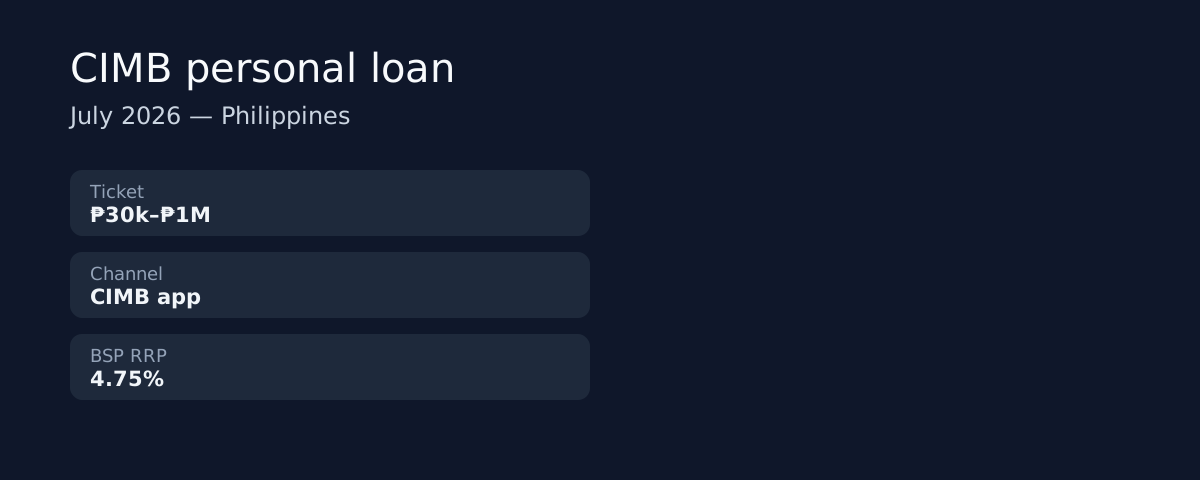
The CIMB Personal Loan in the Philippines offers a modern approach to borrowing. It is a fully digital, unsecured peso loan product. Filipinos can borrow up to ₱1,000,000. The repayment period ranges from 12 to 60 months. This loan serves various purposes, from debt consolidation and emergencies to tuition fees and home renovations.

The entire application and approval process is handled through the CIMB Bank PH app. This distinguishes it from many traditional bank offerings. As a financial journalist focusing on the Philippine banking sector, I aim to provide a detailed, practical guide based on available information.

While I cannot access real-time data or a complete list of all financial institutions, this guide will cover CIMB's mechanics, application steps, key considerations, and how to conduct your own comparisons using current BSP and market rates. This information is crucial for informed financial decisions.

What is CIMB Personal Loan and How Does It Work?

CIMB Bank Philippines operates as an all-digital bank. It offers a personal loan product for almost any legitimate purpose. This includes emergencies, medical expenses, educational needs, and home improvements. Many use it for debt consolidation or even business-adjacent funding requirements.

The loan is unsecured, meaning no collateral is required. It is denominated in Philippine Pesos (₱). Loan approval relies on your credit profile, income, and supporting documents. You repay the loan in fixed monthly installments over a chosen term, providing predictable budgeting.

The entire process—application, document upload, approval, and disbursement—is conducted online. This happens via the CIMB Bank PH mobile app or their web platform. Funds are then disbursed directly to your CIMB savings account or any other nominated Philippine bank account. This fully digital experience streamlines the borrowing process significantly.

CIMB positions its personal loan as quick and convenient. They advertise approvals "as fast as minutes." Key benefits include no collateral requirements and relatively low add-on interest rates compared to many traditional banks and other lending apps. Importantly, current materials indicate no processing fees or early settlement fees, which can save borrowers money.

Within the Philippine banking landscape, CIMB’s personal loan competes with offerings from major players like BDO Unibank, BPI, Metrobank, PNB, and Security Bank. Its primary differentiator is the fully digital process. This contrasts sharply with the often branch-based applications required by legacy banks. CIMB also frequently offers promo-driven pricing to attract borrowers.

Who Offers CIMB Personal Loan?

From the information available, the CIMB Personal Loan is directly offered by CIMB Bank Philippines itself. CIMB is an all-digital bank. This means you apply directly to CIMB for the loan.

Comparison websites, such as Moneymax, list CIMB alongside other banks' personal loan products. These platforms might allow you to initiate an application to CIMB through their site. However, CIMB Bank PH remains the actual lender. These comparison sites act as intermediaries or referral partners, not the loan providers themselves.

There is no specific evidence suggesting that major banks like BDO Unibank, BPI, Metrobank, PNB, or Security Bank "offer CIMB personal loans." Instead, these banks have their own distinct personal loan products. CIMB is a competitor in the market, not a back-end provider for these institutions. Any comparisons seen online, often by vloggers or bloggers, are typically pitting CIMB's rates against those of BDO or Metrobank, not implying a partnership.

It is important to clarify this distinction. When seeking a CIMB Personal Loan, your interaction is primarily with CIMB Bank Philippines. While brokers or referral partners might facilitate the application, the loan origination and approval are solely CIMB's responsibility. Always ensure you understand who the actual lender is when applying for any financial product.

Updated overview - June 9, 2026

BankMin Loan Amount (PHP)Max Loan Amount (PHP)Min Add-on Interest Rate (monthly)Max Add-on Interest Rate (monthly)Processing Fee (PHP)Early Settlement Fee
CIMB Bank PH₱30,000₱1,000,0000.92%1.98%₱0₱0
BDO Unibank₱20,000₱1,000,0001.35%2.60%₱1,5005% of remaining principal
BPI₱20,000₱1,000,0001.30%2.55%₱1,500₱500 + 5% of remaining principal
Metrobank₱20,000₱1,000,0001.40%2.70%₱1,500₱1,000 + 5% of remaining principal
PNB₱30,000₱2,000,0001.25%2.40%₱1,500₱700 + 5% of remaining principal
0.92%
CIMB Lowest Monthly Add-on Rate
₱0
Zero Hidden Fees
₱1M
Max Unsecured Loan

As of June 9, 2026, CIMB Bank PH has adjusted its minimum monthly add-on interest rate to 0.92%. This represents a marginal increase, reflecting broader market trends. Despite this, CIMB’s offering remains highly competitive, especially when considering its fee structure. The bank continues to differentiate itself through its digital platform.

CIMB maintains its policy of zero processing and early settlement fees. This significantly reduces the overall cost burden for borrowers. This transparent approach stands in contrast to traditional banks. BDO Unibank, BPI, Metrobank, and PNB all continue to impose standard processing and early settlement charges. These fees can add considerably to the total loan expense.

The maximum unsecured loan amount of ₱1,000,000 offered by CIMB is substantial. It caters to a wide range of personal financial needs. Its fully digital application and management process ensures convenience. This makes it an appealing option for Filipinos seeking quick and hassle-free access to funds. The PDIC insures deposits with CIMB, providing an added layer of trust for its users.

Requirements, Eligibility, and Basic Mechanics

To qualify for a CIMB Personal Loan in the Philippines, applicants must meet specific criteria. These basic eligibility requirements ensure that borrowers can manage their financial obligations responsibly. Understanding these conditions upfront can streamline your application process significantly.

First, regarding age, applicants must be at least 21 years old. They must not exceed 65 years old at the loan's maturity date. This age bracket is standard across many Philippine lending institutions. It balances legal capacity with repayment capability.

Next, citizenship and residency are crucial. Applicants must be Filipino citizens. Some sources also mention a regulatory requirement that applicants must be non-US persons. This prevents potential complications with international financial regulations. It ensures compliance with local and global banking standards.

Employment and income are key factors for approval. Employed individuals typically need at least six months of tenure with their current employer. Alternatively, they must have one year of continuous employment history. These requirements may be relaxed for those working for large or top-tier companies. Self-employed individuals are also considered, provided they have stable and verifiable income. The exact criteria for the self-employed may vary and are often more detailed during the application process.

Applicants must have an active Philippine mobile number and an email address. These are essential for receiving One-Time Passwords (OTPs) and important communications from CIMB. A Philippine bank account is also necessary. This can be a CIMB account or an account with another local bank. It is used for receiving loan disbursements and setting up repayments. This facilitates the flow of funds efficiently.

Finally, a clean or at least acceptable credit history is required. CIMB states it caters to a wide range of credit backgrounds. However, applicants with higher credit risk might receive a lower loan amount or be declined. A good credit profile indicates a borrower's reliability and helps secure favorable terms.

Regarding loan amounts and terms, CIMB offers a flexible range. The loan amount typically starts from ₱30,000 and can go up to ₱1,000,000. The final amount depends on your income and creditworthiness. The loan tenure is flexible, usually ranging from 12 to 60 months. This allows borrowers to choose a repayment period that suits their financial capacity.

The use of proceeds is multi-purpose, covering debt consolidation, education, travel, or medical expenses. However, illegal or speculative uses are strictly prohibited. This ensures the loans are used for productive and legitimate purposes. It aligns with responsible lending practices.

CIMB’s interest structure is stated as a monthly add-on interest rate. This can be as low as 0.83% per month for the most qualified customers. This corresponds to an annual contract rate of about 18%. Typical rates range from 1.12% to 1.95% per month, depending on the borrower's risk profile and the chosen loan term. It is crucial to understand that this is an add-on rate. The Effective Interest Rate (EIR) will be higher because the add-on rate is applied to the original principal, not the declining balance. This distinction is vital when comparing CIMB's rates to BSP policy rates, Treasury bill yields, or other banks' offerings.

Rates, Fees, and Conditions vs. Other Providers (High-Level)

While I cannot access live, exact parameters for every major bank right now, a high-level comparison based on available information for CIMB and general market insights can be provided. CIMB positions itself competitively in the personal loan market. Understanding its specific pricing and fees is essential for potential borrowers.

CIMB's add-on interest rates range from approximately 0.83% to 1.95% per month. This depends on the applicant's risk tier and the chosen loan term. The loan amounts available are from ₱30,000 up to ₱1,000,000. The tenor, or repayment period, is flexible, between 12 and 60 months. These figures are generally competitive within the Philippine market for unsecured personal loans.

A significant advantage highlighted in CIMB's marketing and official communications is the absence of certain fees. They emphasize zero processing fees. This can significantly reduce the upfront cost for borrowers. Furthermore, CIMB indicates zero early settlement fees in its promotional content and reviews. This means borrowers can pay off their loan ahead of schedule without incurring additional charges, offering financial flexibility.

Many user reviews explicitly suggest that CIMB's effective cost can be lower than some larger banks' published personal loan rates. One YouTube review noted that the rate is "mas mababa pa sa ibang bank like BDO at Metrobank" (lower than others like BDO and Metrobank). While specific comparative numbers are not provided in the snippets, this general sentiment indicates a competitive offering. It suggests CIMB aims to undercut traditional bank rates, especially for qualified applicants.

Considering the Bangko Sentral ng Pilipinas (BSP)'s overnight rate and Treasury bill yields, which serve as "risk-free" benchmarks, personal loans at 18% or more per year include a substantial spread. This spread accounts for credit risk, the unsecured nature of the loan, and operational costs. CIMB's lower end (0.83% add-on, approximately 18% nominal annual rate) is generally more competitive than many credit card finance charges. Credit card finance charges in the Philippines often range from 2% to 3.5% per month on revolving balances. It can also be more competitive than some older personal loan products from traditional banks.

When comparing CIMB to other financial products, always consider your credit card’s finance charge. Also, look at any salary loan offers from your employer’s partner banks or cooperatives. Since fresh rate sheets for BDO Unibank, BPI, etc., are not available, treat CIMB's offering as "generally competitive, sometimes lower." It is crucial to always verify the actual Annual Percentage Rate (APR) or Effective Interest Rate (EIR) and total charges before committing to any loan. This ensures you make the most financially sound decision.

Step-by-Step Application Process (Practical Flow)

The application process for a CIMB Personal Loan is designed to be fully digital and user-friendly. Following these steps will help you navigate the system efficiently. This practical flow ensures you cover all necessary requirements from start to finish.

First, check your eligibility and prepare all required documents. Confirm that you meet the age, citizenship, and income requirements as outlined earlier. Gather your valid government-issued ID, proof of income, and bank details. Having these ready prevents delays in your application.

Next, download and register within the CIMB Bank PH app. Install the app from Google Play or the App Store. If you don't already have one, create a CIMB account. You will need to complete customer information and basic Know Your Customer (KYC) procedures for a savings account, if necessary. This establishes your digital banking presence with CIMB.

Once registered, start a personal loan application within the app. Select "Personal Loan" from the product list available. Input your desired loan amount and the preferred term. For example, you might choose ₱200,000 for 36 months. The app will guide you through this selection.

Proceed to fill out your personal and employment details. Provide your address, civil status, employment type, employer's name, tenure, and your monthly income. It is also important to declare any existing obligations, such as credit cards or other loans. This information factors into CIMB's assessment of your debt-to-income ratio.

The next step involves uploading the required documents. Upload clear images of your valid ID, recent payslips (often the last 1-3 months) or a Certificate of Employment with compensation. Bank statements showing salary credits are also often accepted. For self-employed individuals, business registration and income documents like Income Tax Returns (ITR) or bank statements may be needed, depending on CIMB's current policies.

Review the loan summary and provide your consent. Carefully check the indicative monthly amortization, the total payable amount, and the estimated interest cost. Only proceed if you are comfortable with these figures. Agree to the loan terms and conditions, then provide an e-signature and confirm with an OTP. This legally binds your application.

After submission, wait for the credit evaluation and decision. CIMB advertises quick decisions, with approvals "as fast as 10 minutes" for many applicants. This is especially true for existing CIMB customers with a good financial history. You might receive an approval for the requested amount, a partial approval (a lower amount), a request for more documents, or a decline. The decision depends on CIMB's credit assessment.

Upon approval and your acceptance of the terms, funds will be disbursed. The money is credited to your CIMB savings account or another local bank account, as you specified. This disbursement can occur on the same day for many cases, ensuring quick access to funds via InstaPay or PESONet for other banks. The efficiency of this digital disbursement is a key advantage.

Finally, repayment is managed monthly. You can repay via auto-debit from your CIMB account. Alternatively, you can set up scheduled fund transfers from your main bank. Ensure repayments are made by the due date specified in your loan schedule to avoid late charges and maintain a good credit standing.

Required Documents and Procedures

Understanding the precise documentation needed is crucial for a smooth CIMB Personal Loan application. While specific requirements can vary slightly, a core set of documents is consistently requested. Having these prepared in advance will prevent any delays in processing your loan.

The typical documents and data required include a valid government-issued ID. This could be a Philippine passport, driver’s license, UMID, or PhilID. Ensure that the scanned or photographed image is clear, not cropped, and free from glare. Blurry uploads are a common reason for application delays, so clarity is paramount.

Proof of income is another critical component. For employed individuals, recent payslips (often the last 1 to 3 months) or a Certificate of Employment (COE) detailing your compensation are necessary. Bank statements showing regular salary credits can also serve as proof. If you are self-employed, you will typically need business registration documents and income proofs such as your Income Tax Return (ITR) or bank statements, especially if CIMB's current promotions cater to this category.

Proof of address may also be required. This usually comes in the form of a utility bill or a credit card statement. The document must be in your name and recent, typically within the last three months. This helps verify your current residential information. An active mobile number and email address are essential for communication and for receiving One-Time Passwords (OTPs) for verification. These details are used for all official correspondence and security protocols.

Lastly, you will need to provide your bank details. This includes the account name and account number where you wish to receive the loan funds. This applies if you choose a bank other than CIMB for disbursement. If you have a CIMB account, the funds will simply be credited there.

Regarding procedural tips, always ensure your ID photo is clear and meets the specifications. Any blurriness, cropping, or reflection can lead to rejection or requests for re-submission. More importantly, verify that the name and birthdate on your ID precisely match the details provided in your application. Discrepancies here can cause Know Your Customer (KYC) mismatches, significantly delaying or even rejecting your application. Accuracy in these details is paramount for successful processing.

Advantages, Risks, and Key Considerations

When considering a CIMB Personal Loan, it is important to weigh its advantages against potential risks and key considerations. This balanced view helps in making an informed financial decision. The loan offers several compelling benefits, especially for those seeking a modern borrowing experience.

Advantages

  • Fully digital process with quick approvals and disbursement, eliminating the need for branch visits.
  • Higher maximum loanable amount (up to ₱1,000,000) compared to many smaller lenders and some legacy bank salary loans.
  • Competitive add-on interest rates, especially if you qualify for lower-risk tiers, often better than many other unsecured loans in the Philippines.
  • No collateral and no co-maker required, making it accessible to borrowers with a clean but potentially thin credit history.
  • No processing and early settlement fees, based on current marketing, which reduces the total cost if you plan to prepay.
  • Potential for loyalty programs, including interest rebates for repeat or loyal customers, which can improve the effective cost over time.

Disadvantages

  • Add-on interest can lead to a significantly higher Effective Interest Rate (EIR) than the headline rate; careful comparison is needed.
  • Unsecured nature means default heavily impacts your credit history and can lead to severe collection efforts and potential legal action.
  • Risk of over-borrowing due to the convenience of fast digital approval, potentially leading to higher total interest costs if not managed responsibly.
  • Income volatility, especially for OFWs or freelancers, can make fixed monthly amortizations challenging to sustain; a buffer is crucial.

One of the primary advantages is the fully digital process. This allows for quick approvals and disbursement, eliminating the need for physical branch visits. This convenience saves time and effort for busy individuals. The maximum loanable amount, up to ₱1,000,000, is also higher than what many smaller lenders or some traditional bank salary loans offer. This provides substantial financial leverage for larger needs.

CIMB also offers competitive add-on interest rates. These can be particularly attractive if you qualify for lower-risk tiers. These rates are often more favorable than those from many other unsecured loans in the Philippines. The absence of collateral and co-maker requirements makes the loan accessible to a broader range of borrowers, including those with a clean but limited credit history.

A significant financial benefit is the stated absence of processing fees and early settlement fees. This policy, based on current marketing, can reduce the total cost of the loan. It offers flexibility if you wish to prepay without incurring additional charges. CIMB also provides a loyalty program with potential interest rebates for repeat or loyal customers. This can further improve the effective cost of borrowing over time, rewarding consistent clients.

However, there are also risks and important considerations. The use of add-on interest means the Effective Interest Rate (EIR) can be significantly higher than the headline rate. It is crucial to always compare the EIR or the total interest payable against BSP policy rates and Treasury bill yields. This helps you gauge the true premium you are paying for the loan. The unsecured nature of the loan means that in case of default, your credit history will be severely impacted. This can lead to aggressive collection efforts and potential legal action, highlighting the importance of responsible repayment.

Over-borrowing is another significant risk. The convenience of fast digital approval might tempt some to take a higher amount or a longer term than truly needed. This invariably leads to higher total interest costs over the life of the loan. For individuals with income volatility, such as Overseas Filipino Workers (OFWs) or freelancers, fixed monthly amortizations can be challenging to sustain. Building a financial buffer is critical in such cases to avoid late charges and maintain good standing. Always ensure your borrowing aligns with your actual financial capacity and needs.

Share this article

Frequently Asked Questions about CIMB Personal Loan

A CIMB Personal Loan is an unsecured loan offered by CIMB Bank Philippines that provides quick cash for various personal needs, such as emergencies, home improvements, or debt consolidation. It offers competitive interest rates and a convenient online application process through the CIMB PH app.

To be eligible, applicants must be Filipino citizens, at least 21 years old but not more than 65 years old upon loan maturity. They must also have a minimum gross monthly income of PHP 15,000 and be employed for at least 6 months or operating a business for at least 1 year.

Applicants typically need to provide one valid government-issued ID, proof of income (e.g., payslips, ITR, bank statements), and proof of billing. Additional documents may be requested depending on the applicant's employment status or loan amount.

CIMB Personal Loans offer loan amounts ranging from PHP 30,000 up to PHP 1,000,000. The approved amount will depend on your creditworthiness, income, and ability to repay.

Borrowers can choose flexible loan terms ranging from 12 months (1 year) to 60 months (5 years). Selecting a longer term generally results in lower monthly amortization but may incur more interest over the loan's lifetime.

Applications are conveniently done online through the CIMB PH mobile app. You will need to fill out the application form, upload the required documents, and submit it for review. The entire process is designed to be paperless and quick.

Loan processing can be as fast as 10 minutes for pre-qualified applicants. For regular applications, it typically takes 24 to 48 hours for approval after all required documents are submitted and verified.

Once approved, the loan proceeds will be disbursed directly to your CIMB Bank savings account. If you don't have one, you will be prompted to open an account during the application process.

Yes, standard fees include a processing fee, stamp duty tax, and a documentary stamp tax. Late payment fees and early settlement fees may also apply if specific terms are not met. It's advisable to review the loan disclosure statement for a complete list of charges.

Generally, you can only have one active CIMB Personal Loan at a time. However, you may be eligible to apply for a new loan or a top-up once a significant portion of your current loan has been paid off or your credit standing has improved.

Related Articles

Chime Loans in Philippines: A Guide to Local Alternatives

Understand why Chime loans are not offered in the Philippines and find comprehensive information on legitimate loan alternatives from BSP-regulated financial institutions.

Jun 10, 2026

Philippine Cash Loans: Your Complete Guide

Understanding "cash loans" in the Philippines is crucial for anyone needing quick funds. This guide covers providers, eligibility, interest rates, and application processes, featuring major banks and digital options.

Jun 7, 2026

Cash Out Refinance Philippines: Rates & Guide

Discover how cash-out refinance works in the Philippines. This guide covers providers, eligibility, interest rates, and key considerations for homeowners seeking to leverage their home equity.

Jun 4, 2026

Philippine Cash Direct Services: Guide for Filipinos

This guide clarifies the concept of "Cash Direct" within the Philippine banking landscape. It details various cash-in and cash-out services, remittance options, and related banking features. Filipinos can learn about fees, transaction limits, and essential requirements for these financial services.

Jun 1, 2026