





Buying a car in the Philippines often involves securing an auto loan. This financial product allows you to acquire a vehicle by making an initial down payment. The remaining balance is then repaid in fixed monthly installments. This guide explores the mechanics of car finance in the Philippine market.
You will learn about the major financial institutions offering these loans. We cover what costs are involved and how to navigate the application process. Understanding these aspects helps ensure a safe and informed decision in today's local automotive landscape.
1. Understanding Car Finance in the Philippines
Car finance in the Philippines typically refers to an auto loan from a bank or financing company. This loan enables you to purchase a vehicle. You pay an initial down payment, usually ranging from 20% to 50% of the car's price. The remaining amount is then financed.
The repayment period for these loans can span from 12 to 84 months. Monthly installments cover the principal, interest, and sometimes additional fees and insurance. The car itself serves as collateral for the loan. If you fail to meet your payment obligations, the lender has the right to repossess the vehicle.
Most major banks and many specialized finance companies offer these loans. This includes Japanese OEM-backed lenders like Toyota Financial Services. They provide financing for both new and used cars. All loan terms are denominated in Philippine pesos (₱).
2. Major Banks and Financial Institutions Offering Car Finance
The Philippine market offers numerous options for car financing. Both traditional banks and specialized finance companies provide auto loans. These institutions are regulated by the Bangko Sentral ng Pilipinas (BSP).
Deposits in banks are covered by the Philippine Deposit Insurance Corporation (PDIC). This coverage is up to ₱500,000 per depositor per bank. However, PDIC coverage applies only to deposits, not to the loan balance itself. The following list includes major players active in 2025.
| Institution Type | Key Players |
|---|---|
| Big Universal Banks | BDO Unibank (BDO Auto Loan), Bank of the Philippine Islands (BPI Auto Loan), Metrobank (Metrobank Auto Loan), Philippine National Bank (PNB Auto Loan), Security Bank (Security Bank Auto Loan), RCBC, UnionBank, Bank of Commerce, PBCOM, PSBank, Sterling Bank of Asia, AUB (Motor Vehicle Loans), Maybank Philippines (Auto Loan) |
| Specialized/Non-Bank Financiers | Toyota Financial Services, Nippon Leasing Auto Finance, various in-house financing schemes from car dealers (e.g., Toyota, Honda, Mitsubishi, Hyundai) |
Updated overview - June 25, 2026
| Bank | EIR Range (New Car) | Key Features |
|---|---|---|
| BDO Unibank | 5.40% – 10.00% | Exclusive deals with automotive showrooms. |
| Bank of the Philippine Islands (BPI) | 5.45% – 10.05% | Value-added services for car maintenance. |
| Metrobank | 5.50% – 10.10% | Expansive network for easy access. |
| Philippine National Bank (PNB) | 5.55% – 10.15% | Customized plans for small business owners. |
| Security Bank | 5.35% – 9.95% | Aggressive promotions for eco-friendly vehicles. |
As of June 25, 2026, the Philippine auto loan market shows continued evolution. BDO Unibank offers exclusive deals through its partnerships with automotive showrooms. This provides added value for their clients. BPI is bundling value-added services such as car maintenance packages. This enhances their overall offering.
Metrobank benefits from an expansive branch network. This ensures easy access for borrowers nationwide. PNB introduces customized plans specifically for small business owners. This helps them acquire vehicles for commercial use.
Security Bank continues its aggressive promotions for eco-friendly vehicles. They maintain the lowest rates in this segment. The market trends indicate a strong focus on competitive rates, customer convenience, and sustainable solutions.
These entities provide financing for a wide range of vehicles. They cater to different customer profiles. Always verify the specific terms and conditions with each provider.
3. Requirements, Eligibility, and Application Basics
To qualify for an auto loan in the Philippines, applicants must meet certain criteria. These criteria vary slightly among banks but share commonalities. Most lenders require applicants to be between 21 and 65 years old. Some banks may accept applicants as young as 18 or 20.
Applicants must generally be Filipino citizens. Foreign residents with valid visas and proof of income may also be considered. A stable monthly income is crucial. The minimum gross monthly income often ranges from ₱20,000 to ₱30,000. This depends on the bank and the requested loan amount.
A clean credit history is preferred. Some banks may approve applicants with "thin files" but might require a co-maker or guarantor. Loan amounts typically range from ₱100,000 to ₱10 million. This depends on the vehicle price and the bank's policies. Most banks cap the loan-to-value (LTV) at 80% of the car's market value. Loan tenors usually range from 12 to 60 months, though some banks like Maybank offer up to 84 months.
4. Interest Rates and Fees in Car Finance
Auto loan pricing in the Philippines is influenced by several economic factors. The BSP policy rate, currently around 6% for 2025-2026 discussions, affects banks' cost of funds. This directly impacts the base interest rates they apply to loans. Additionally, 91-day T-bill yields serve as a benchmark. Banks often peg their auto loan spreads to these rates, adding premiums for credit risk and loan term.
Effective annual interest rates (EIR) for new car auto loans in 2025 typically range from 5.5% to over 10% per year for big universal banks. Rates may vary based on the client's tier, such as basic versus Premier clients. Maybank, known for longer-term options, starts around 5.3% to 6%. However, these rates can increase for extended tenors or higher-risk clients. Other banks and smaller lenders might charge 8% to 15% or more, especially for used cars or lower-income applicants.
| Lender Type | Approximate EIR Range (New Car) | Notes |
|---|---|---|
| Big Universal Banks | 5.5% – 10%+ per year | Client tier can influence rates. |
| Maybank (Longer Terms) | 5.3% – 6%+ | Higher for longer terms or riskier profiles. |
| RCBC | 5.35% – 28.76% | Wide range based on credit and term. |
| Other Banks / Smaller Lenders | 8% – 15%+ | Higher for used cars or lower income. |
Beyond interest rates, several fees contribute to the total cost of credit. Processing or credit investigation fees usually range from ₱1,000 to ₱5,000. These can also be a percentage of the loan amount. Documentation or legal fees may apply, especially if the contract is registered with the Land Transportation Office (LTO) or Bureau of Motor Vehicles (BMV). Comprehensive motor insurance is often a mandatory requirement. Some banks may encourage or even bundle their own insurance plans. A prepayment penalty, typically 1% to 3%, might be charged if you decide to pay off the loan early. Always ask for the Clear/Total Cost of Credit (TCC) in ₱ over the full term, not just the monthly rate, to understand the complete financial obligation.
5. Step-by-Step Car Loan Application Process
Applying for a car loan in the Philippines involves a structured process. This ensures both you and the bank meet all necessary requirements. The journey begins with careful self-assessment and budgeting. First, choose your desired car brand and model. Obtain an official price quotation from the dealer. Then, estimate an affordable monthly amortization. This should ideally not exceed 30% to 40% of your net monthly income.
Next, you can pre-qualify or pre-apply for the loan. Many banks like BDO Unibank, BPI, Metrobank, and RCBC offer online application forms or loan calculators. These tools provide a preliminary approval and an estimated monthly payment. Some banks allow "soft checks" during this stage. These checks do not negatively affect your credit score.
The next critical step involves submitting all required documents to the bank. This includes valid IDs, income proofs, and evidence of your down payment. If you are using dealership financing, the bank may coordinate directly with the dealer. The bank will then conduct an evaluation and credit check. They review your income, expenses, and credit history through agencies like CIBI or the Credit Information Corporation (CIC). A high Debt-to-Income ratio might lead to a lower loan amount. Alternatively, the bank may require a co-maker.
Upon approval, the bank issues a loan approval letter and a Sample Amortization Schedule in ₱. You will then sign the Deed of Chattel Mortgage (DCM) and, if applicable, the Deed of Assignment (DOA). The final stages involve paying the down payment directly to the dealer or bank. The bank then releases the loan proceeds to the dealer. The car title is registered with the bank as the lienholder. The dealer or finance company usually handles LTO registration and comprehensive insurance. You then begin your monthly repayments. These can be done via auto-debit or online banking. Missing payments can lead to penalties and even repossession.
6. Required Documents for Auto Loan Applications
While specific requirements can vary, banks in the Philippines generally ask for a standard set of documents. These are categorized based on your employment status. For employed applicants, you will need valid government-issued IDs. Examples include a passport, driver’s license, SSS UMID, or PRC ID. Proof of address is also necessary, such as a utility bill, credit card statement, or barangay certificate.
Income verification includes your latest 2-3 months’ payslips or an employment certificate. Additionally, provide your latest 1-3 months’ bank statements. Some banks may also request SSS/GSIS/UMID data. For self-employed individuals or business owners, the requirements differ. You will need business registration documents like DTI/SEC. Latest audited financials or Income Tax Returns (ITR) are also crucial. Provide recent bank statements, both personal and business, if applicable. A business permit or corporate documents are necessary if the car is for business use.
Loan-specific documents include a duly accomplished auto-loan application form. A car quotation or sales invoice from the dealer, showing the exact price in ₱, is essential. Once issued, a copy of the motor insurance policy is also required. Banks and dealers often manage the LTO registration and title processing. However, you must sign the Deed of Chattel Mortgage (DCM). This ensures the bank is noted as the lienholder on the Certificate of Registration (COR).
7. Advantages, Risks, and Key Considerations
Opting for car finance in the Philippines offers several advantages. It allows you to spread out a significant expense. You can drive a car immediately by paying only 20-50% down. The remaining balance is paid in manageable monthly installments in ₱. Regular loan payments can also help build your credit history. This can be beneficial for future loan applications. Fixed-term amortization schedules aid in budgeting over a 1 to 7-year period.
Advantages
- Drive immediately with low down payment.
- Builds positive credit history with consistent payments.
- Predictable monthly budgeting with fixed amortization.
- Payments are in Philippine Pesos (₱).
Disadvantages
- Risk of repossession upon payment default.
- Potential for hidden costs (fees, bundled insurance).
- Longer terms increase total interest paid.
- Exchange-rate risk for imported vehicle prices.
However, car finance also carries risks and considerations. The most significant risk is repossession. Defaulting on your loan payments can lead to the bank taking back your car. This also damages your credit score. Be aware of potential hidden costs. These include processing fees, bundled insurance packages, and prepayment penalties. Always insist on knowing the all-inclusive cost in ₱ over the full loan term. Consider the impact of loan tenor on total cost. A longer term, such as 84 months, lowers monthly payments. Yet, it substantially increases the total interest paid over the loan's lifetime.
For imported cars, exchange-rate risk is a factor. The price in ₱ might be affected by currency fluctuations and import duties. It is crucial to compare bank financing with in-house or dealership financing. Banks often offer lower interest rates but involve more paperwork. Dealerships might provide greater convenience and promotional offers. However, their overall costs can sometimes be higher. Thorough comparison helps in making an informed financial decision.
8. BSP Regulations, PDIC Coverage, and Market Trends
The Bangko Sentral ng Pilipinas (BSP) actively regulates auto loans. These are classified as consumer or household loans. BSP's consumer-lending and fair-lending rules aim to prevent abusive fees. They also mandate clear disclosure of terms. These regulations protect consumers from unfair collection practices. The BSP requires banks to conduct Know-Your-Customer (KYC) procedures. Credit-risk assessments are also mandatory before approving any auto loan.
The Philippine Deposit Insurance Corporation (PDIC) provides deposit insurance. This covers up to ₱500,000 per depositor per bank. It is important to note that this coverage applies only to deposits, not to outstanding loan balances. If a bank fails, PDIC reimburses your savings or current deposits. However, you are still obligated to repay your loan to the successor bank or receiver.
Auto loan interest rates are closely tied to financial market indicators. Many banks peg their loan spreads to the 91-day T-bill rates. These rates reflect what the government pays for short-term borrowing. A markup is then added to account for credit and term premiums. With the BSP policy rate hovering around 6% (typical for 2025-2026), T-bill-linked spreads generally keep base auto loan rates between 5% and 7% for prime borrowers. Riskier profiles will incur higher spreads.
Current market trends (2025-2026) show strong demand for practical vehicles. SUVs, small vans, and pickups are popular due to commuting and family needs. Digitalization is also transforming the auto loan application process. More banks and dealers now offer online applications. E-signatures and e-payments via InstaPay or PESONet are becoming common. This reduces the need for in-branch paperwork. Green financing is an emerging trend. While limited, incentives for hybrid and electric vehicles are growing. These sometimes come with special promotional rates from manufacturers or banks.
9. Expert Tips and Recommendations
When considering an auto loan in the Philippines, smart financial planning is key. Adhere to the "30% rule" for debt. Ensure your total monthly debt payments, including all loans, do not exceed 30-40% of your net take-home pay. This helps maintain financial stability.
Always compare offers based on the total amount payable in ₱. Do not focus solely on monthly amortization figures. This approach reveals the true cost of each loan option. It helps you identify the cheapest financing available.
Utilize online pre-qualification tools from major banks. BDO Unibank, BPI, Metrobank, and RCBC offer these services. Pre-qualifying helps you understand your eligibility without affecting your credit score. This avoids multiple "hard inquiries" that could negatively impact your credit standing.
Finally, always be prepared to negotiate. Inquire about potential waivers or discounts on processing fees. A little negotiation can lead to significant savings over the loan term. This proactive approach ensures you get the most favorable terms for your car finance in the Philippines.
Expert analysis - June 25, 2026
The auto loan market is demonstrating remarkable resilience and adaptability. The average base EIR has continued its subtle decline. This reflects fierce competition and banks' efforts to streamline operations. Consumers are now in a strong position to negotiate favorable terms.
BPI's strategy of including value-added services for car maintenance is a clever way to differentiate. This provides a tangible benefit beyond the loan itself. Such offerings can influence customer loyalty and improve perceived value. It also simplifies car ownership for borrowers.
Security Bank's sustained focus and aggressive promotions for eco-friendly vehicles position them well for future growth. As environmental consciousness grows, demand for such vehicles will increase. Banks that align with these values early will gain a significant advantage. The robust growth in the total auto loan portfolio underscores the health of the sector.
July 2026 car finance snapshot
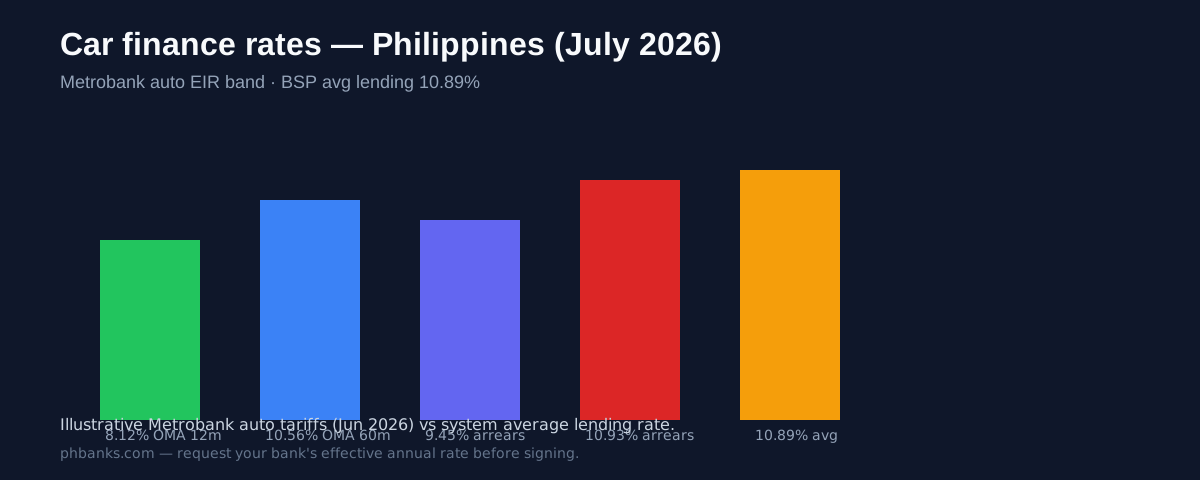
Auto finance pricing in July 2026 tracks a tight BSP stance: the Target RRP is 4.75%, while the average actual bank lending rate was 10.89% in late June 2026 across all maturities.
Metrobank's published auto-loan effective rates (June 2026) span 8.12% to 10.93% p.a. for 12–60 month terms, with lower figures for one-month-advance payment and higher figures for in-arrears structures. Use this published band when comparing dealer in-house finance against bank auto loans.
| Rate benchmark | July 2026 context |
|---|---|
| BSP Target RRP | 4.75% |
| System avg lending rate | 10.89% (late Jun 2026) |
| Metrobank auto EIR (published) | 8.12% – 10.93% p.a. |
Source: BSP and Metrobank auto-loan tariff materials in PH-A notebook July 2026. Always request a peso amortization schedule and total cost of credit.