






Secured loans in the Philippines are a cornerstone of personal and business finance. These financial products require borrowers to pledge an asset as collateral. Common examples include real estate properties or vehicles. This collateral significantly reduces the risk for lenders. As a result, secured loans often come with more attractive interest rates. They are typically lower than those offered on unsecured lending options.
Major banks across the Philippines widely offer various types of secured loans. These institutions operate under strict regulations set by the Bangko Sentral ng Pilipinas (BSP). The BSP's oversight ensures consumer protection and maintains stability in the financial system. Understanding the nuances of secured loans is crucial for any Filipino borrower. This guide provides a detailed look into the landscape of secured lending in the country.
Understanding Secured Loan Basics in the Philippines
A secured loan fundamentally requires a borrower to provide collateral. This asset acts as a guarantee for the lender. If the borrower fails to repay the loan, the lender can seize and sell the pledged asset. In the Philippine context, popular forms of collateral include residential properties for home loans. Vehicles are used for auto loans. Some loans can even be secured by bank deposits or valuable jewelry.
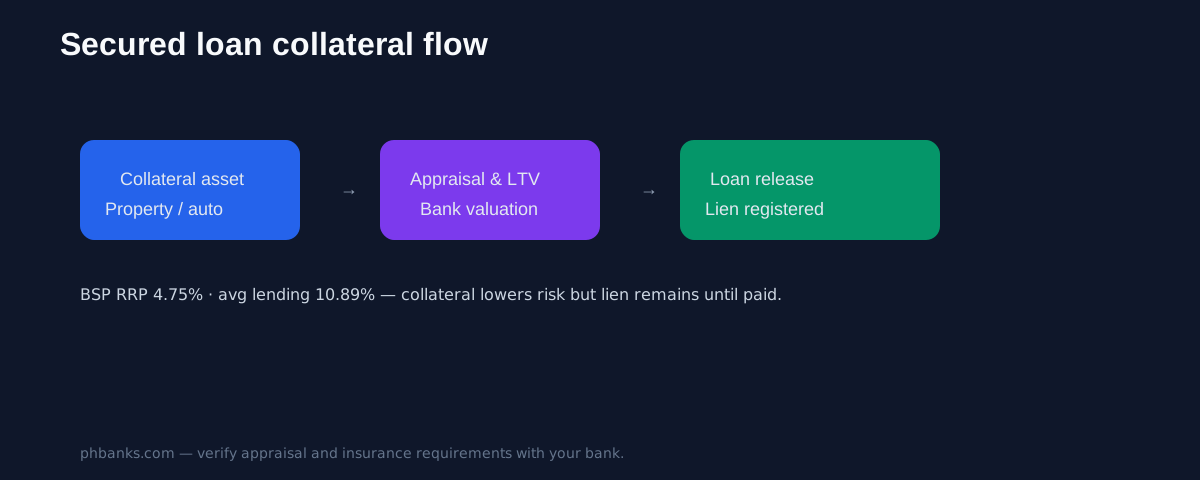
The lending process for a secured loan involves several key steps. First, the bank appraises the value of the proposed collateral. This appraisal is often conducted by bank-hired assessors. They determine the fair market value of the asset. Based on this valuation, banks typically approve a loan amount. This amount usually ranges from 70% to 90% of the collateral's appraised worth. A lien or hold is then registered against the asset. This legal claim remains until the loan is fully repaid.
Interest on secured loans is generally calculated on a diminishing balance basis. This means interest is charged only on the remaining principal balance. Calculations can be daily or monthly, depending on the bank. The prevailing interest rates are heavily influenced by the BSP's monetary policy. For instance, the BSP overnight reverse repo rate, around 5.75% as of early 2026, acts as a benchmark. Philippine Treasury bill yields, like the 91-day T-bill at approximately 5.5%, also play a significant role in determining loan rates.
Major Secured Loan Providers
Several prominent financial institutions in the Philippines offer secured loan products. These banks cater to various needs, from housing to vehicle acquisition. BDO Unibank, one of the largest banks, provides competitive Peso Auto Loans and Home Loans. BPI (Bank of the Philippine Islands) is another major player. They also offer strong Auto Loan and Home Loan programs. Metrobank features its Metrobank Home Loan and Car Loan. PNB (Philippine National Bank) is known for its PNB Car Loan and Housing Loan options. Security Bank offers both Auto Loan and Home Loan products.
Beyond these leading commercial banks, other institutions also contribute to the secured lending market. UnionBank and Robinsons Bank provide various secured loan facilities. Landbank of the Philippines specializes in loans backed by agricultural collateral. The Pag-IBIG Fund offers housing loans, often tied to their members' Modified Pag-IBIG II (MP2) savings. The Social Security System (SSS) provides salary loans. These loans are secured against future pension benefits. Rural banks, such as GDFI, cater to micro-secured loans, often supporting local communities.
The rise of digital banking has also introduced new players. Non-bank financial institutions like Tonik Bank offer digital secured options. These often involve loans against deposits. Digido also provides digital lending solutions. Borrowers should always check the official websites of these providers. They should look for detailed information on PHP-denominated products and current offerings. Always ensure to compare terms and conditions before committing.
Updated overview - June 29, 2026
| Provider | Rate (p.a.) | Max Term (Auto) | Processing Fee | Min Loan |
|---|---|---|---|---|
| BDO Unibank | 7.1-10.2% | 60 mo | 2.0% | ₱100,000 |
| BPI | 6.6-9.1% | 60 mo | 1.0% | ₱70,000 |
| Metrobank | 7.1-11.1% | 84 mo | 2.0% | ₱150,000 |
| PNB | 8.1-12.1% | 60 mo | 3.0% | ₱100,000 |
| Security Bank | 7.6-10.1% | 60 mo | 1.5% | ₱200,000 |
As of June 29, 2026, secured loan rates have seen a marginal upward creep, reflecting minor shifts in the broader economic environment. The BSP's reverse repo rate is at 5.77%, indicating a cautious monetary stance. BPI continues to provide highly competitive rates, particularly for its prime clients.
The 91-day T-Bill yield also increased to 5.5%, aligning with the general trend. Processing fees largely held steady, offering some predictability in overall loan costs. Minimum loan amounts remain consistent across the major banking institutions.

BDO Unibank shows a slight increase in its upper-end rate. This might affect borrowers with lower credit scores. Metrobank's long-term auto loan option continues to offer flexibility. However, all applicants should conduct a thorough cost-benefit analysis before committing to any loan. Always compare the effective interest rate.
Eligibility and Requirements for Secured Loans
To qualify for a secured loan in the Philippines, applicants must meet specific eligibility criteria. Generally, borrowers must be Filipino citizens or permanent residents. Age restrictions typically apply, with applicants needing to be between 21 and 65 years old upon loan maturity. A stable source of income is crucial. Minimum monthly income requirements vary by bank, usually ranging from ₱20,000 to ₱50,000. A clean credit history, as reported by the Credit Information Corporation (CIC), is also essential for approval.
The collateral itself must meet stringent requirements. The property or vehicle must be titled in the applicant's name. It must be free from any existing liens or encumbrances. The appraised value of the collateral must also exceed the desired loan amount. Banks often require specific employment statuses. Employed individuals usually need at least six months of tenure with their current employer. Self-employed applicants must demonstrate at least two years of profitable business operations. Overseas Filipino Workers (OFWs) need to provide proof of remittances to qualify.
The Secured Loan Application Process
The application process for secured loans can begin either online or by visiting a bank branch. The initial step involves submitting all required documents. After document submission, the bank initiates an appraisal of the collateral. Simultaneously, a thorough credit check is conducted through the CIC. This phase typically takes one to two weeks to complete. Upon successful appraisal and credit verification, the loan receives approval. The borrower then signs the loan contract. Funds are released only after the collateral's title is properly annotated with the bank's lien. Digital banks like Tonik can significantly shorten this process, often to just a few days.
Here is a step-by-step breakdown of a typical secured loan application: First, compare rates and terms from various providers. Second, meticulously prepare all necessary documents. Third, submit your application, either via a mobile app or at a physical branch. Fourth, cooperate with the collateral appraisal process. Fifth, await loan approval. Sixth, sign the notarized loan agreement. Seventh, receive the disbursed funds. Finally, ensure timely repayments, often set up via auto-debit from your bank account.
Required Documents for Secured Loans
A comprehensive set of documents is necessary for any secured loan application. Applicants must provide at least two valid government-issued identification cards. Accepted IDs include a passport, driver's license, SSS ID, or GSIS ID. Proof of income is paramount. For employed individuals, this means presenting the latest three months of payslips, your Income Tax Return (ITR), or BIR Form 2316. Self-employed professionals may need to submit a Certificate of Accreditation (COA).
Collateral-specific documents are also critical. For auto loans, the Official Receipt (OR) and Certificate of Registration (CR) of the vehicle are required. For property-backed loans, the Transfer Certificate of Title (TCT) or Condominium Certificate of Title (CTC) must be provided. This title must be clean and unencumbered. Additionally, banks usually ask for the latest six months of bank statements. If applicable, a marriage certificate is needed, especially if a spouse is a co-borrower. An appraisal fee receipt, typically ranging from ₱2,000 to ₱10,000, is also part of the initial requirements. A full list of required documents can always be found on the respective bank websites.
| Document Type | Specific Examples | Purpose |
|---|---|---|
| Valid IDs (2) | Passport, Driver's License, SSS/GSIS ID | Identity Verification |
| Proof of Income | Payslips (3 months), ITR, BIR Form 2316, COA | Repayment Capacity Assessment |
| Collateral Docs | OR/CR (cars), TCT/CTC (land), Clean Title | Asset Verification & Ownership |
| Bank Statements | 6 months of bank account activity | Financial Stability Check |
| Appraisal Fee Receipt | Proof of payment (₱2,000-₱10,000) | Collateral Valuation Service |
Rates and Comparison of Secured Loans
Interest rates for secured loans in the Philippines typically range from 6% to 12% per annum. These rates can be fixed or add-on, depending on the bank and loan product. For instance, BDO Unibank generally offers rates between 7% and 10%. BPI's rates often fall between 6.5% and 9%. Metrobank's offerings usually span 7% to 11%. Prime borrowers with excellent credit scores and substantial collateral often secure the lowest rates. Loan terms vary significantly; auto loans typically range from 12 to 60 months. Home loans can extend much longer, up to 20 to 30 years.
Beyond interest rates, borrowers must consider other associated fees. Processing fees typically range from 1% to 5% of the loan amount. Documentary stamp taxes can add another 0.5% to 1%. Penalties for late payments or pre-termination usually fall between ₱1,000 and ₱5,000. BPI is often noted for having some of the most competitive rates for auto loans. BDO offers flexible tenures for various loan products. It is highly advisable to use amortization calculators available on bank websites. These tools help estimate monthly payments and total costs. Loan rates closely track the BSP's policy rates, such as the 5.75% reverse repo rate.
| Provider | Rate (p.a.) | Max Term | Processing Fee | Min Loan |
|---|---|---|---|---|
| BDO Unibank | 7.0-10.0% | 60 mo (Auto) | 2-3% | ₱100,000 |
| BPI | 6.5-9.0% | 60 mo (Auto) | 1-2% | ₱70,000 |
| Metrobank | 7.0-11.0% | 84 mo (Auto) | 2% | ₱150,000 |
| PNB | 8.0-12.0% | 60 mo (Auto) | 3% | ₱100,000 |
| Security Bank | 7.5-10.0% | 60 mo (Auto) | 1.5% | ₱200,000 |
Advantages and Risks of Secured Loans
Secured loans offer several compelling advantages compared to their unsecured counterparts. Perhaps the most significant benefit is the lower interest rates. Unsecured loans can often carry rates exceeding 20% per annum, while secured loans typically stay within the 6-12% range. They also allow for higher borrowing limits. Borrowers can access significant capital, sometimes up to ₱50 million for large home loans. Additionally, secured loans can be easier to obtain for individuals with less-than-perfect credit histories. The collateral mitigates the lender's risk, making them more willing to approve such applications.
However, secured loans also come with inherent risks that borrowers must understand. The primary risk is the potential loss of collateral. If a borrower defaults on payments, the lender has the legal right to seize the pledged asset. This process, known as foreclosure for property or repossession for vehicles, typically occurs after a grace period, often 90 days. High repossession fees can also be charged. Another consideration is market depreciation. If the collateral's value decreases significantly, the outstanding loan amount might exceed the asset's worth. This erodes the borrower's equity. It is crucial to factor in the Philippine inflation rate, currently around 3%, when assessing long-term repayment capacity. Borrowers should also ensure their total loan repayments do not exceed 40% of their monthly income to maintain financial stability.
Advantages
- Lower interest rates (6-12% vs. 20%+ for unsecured)
- Higher borrowing limits (up to ₱50 million)
- Easier approval even with some credit history issues
- Longer repayment terms (up to 30 years for home loans)
- Structured repayment plans provide financial discipline
Disadvantages
- Risk of collateral loss upon default (foreclosure/repossession)
- Potentially high repossession or foreclosure fees
- Market depreciation can reduce asset equity
- Lengthy application process due to appraisal and documentation
- Requires valuable asset ownership to qualify
BSP Regulations and Market Trends
The Bangko Sentral ng Pilipinas (BSP) plays a critical role in regulating the secured lending market. The BSP mandates that all financial institutions adhere to the Truth in Lending Act. This ensures full disclosure of all charges and interest computations to borrowers. The Philippine Deposit Insurance Corporation (PDIC) provides deposit insurance up to ₱500,000. This is particularly relevant for loans secured by deposit hold-outs. BSP Circular 1141 further requires banks to conduct fit-for-purpose assessments. These assessments ensure that loan products align with the borrower's financial capacity and needs.
Current trends in the Philippine secured loan market include a significant rise in digital applications. Institutions like Tonik are leading this shift, offering faster and more convenient processes. There is also a growing interest in green loan incentives. These encourage borrowing for environmentally friendly investments. Interest rates are expected to remain relatively stable, especially after potential rate cuts post-2025. However, they will continue to be closely tied to T-bill yields, which currently hover around 5.2% to 5.8%. No major regulatory changes for 2026 have been announced by the BSP yet, suggesting continued stability in the lending environment.
Expert Tips for Secured Loan Applicants
For individuals considering a secured loan, a few expert tips can significantly improve the borrowing experience. Always shop around and obtain multiple quotes from different banks. Utilize the BSP's online comparator tool to get an objective view of various loan offerings. If market volatility is expected, try to lock in a fixed interest rate. This protects you from potential rate increases. Making overpayments on the principal amount can substantially reduce the total interest paid over the loan term. It is also wise to insure your collateral, protecting your asset against unforeseen damage or loss. Avoid taking out a secured loan if your equity in the collateral is less than 20% of its value, as this reduces your financial buffer. For overseas Filipino workers (OFWs) or expats with remittance ties, prioritize programs offered by banks like BDO and BPI. These institutions often have tailored products that cater specifically to the unique financial situations of OFWs, facilitating easier loan approval and better terms.
Common Issues and Practical Fixes
Applicants for secured loans sometimes encounter various issues. One common problem is appraisal disputes. If you disagree with the bank's collateral valuation, consider hiring an independent valuer. This typically costs around ₱5,000. Another frequent concern is delayed fund release. To mitigate this, ensure all documents are pre-notarized before submission. Hidden fees can also be a nasty surprise. Always demand full disclosure of all charges under the Truth in Lending Act (TINA) before signing any agreement. If you face the risk of default, do not hesitate to negotiate with your bank for a loan restructuring. The BSP offers mediation services if direct negotiations fail. Lastly, errors on your credit report from the CIC can hinder approval. You have the right to dispute these errors for free. For those in rural areas with limited access to traditional banks, explore micro-secured loans offered by institutions like Pag-IBIG or rural banks like GDFI. These options often have more accessible requirements and cater to local needs, expanding financial inclusion.
Expert analysis - June 29, 2026
The slight upward movement in rates suggests that borrowers should be proactive in their loan applications. While not a drastic change, it could signal a trend. Locking in a fixed rate soon might be a prudent strategy, especially for long-term home loans.
We advise applicants to pay close attention to any changes in eligibility requirements. Banks may tighten their lending criteria in response to subtle economic shifts. Ensuring a strong credit score and stable income proof is more important than ever. Utilize online banking for efficient application tracking.
Consider the total amount payable over the loan's lifetime. A small difference in the annual interest rate can translate into significant savings or additional costs. Use the BSP's financial literacy tools to understand all disclosures. This empowers you to make the most informed decision.
July 2026 secured lending context
Secured loans in the Philippines — backed by real estate, motor vehicles or other assignable assets — still price off the same macro backdrop as unsecured credit. The BSP Target RRP is 4.75% in July 2026, and the average actual bank lending rate was 10.89% in late June 2026.
Collateral reduces lender risk and can improve approval odds, but it does not remove lien registration, insurance requirements or appraisal costs. For auto-backed facilities, published Metrobank effective car-loan rates of 8.12% to 10.93% p.a. (June 2026) illustrate how secured transport loans can sit below the system average yet still carry double-digit effective rates on longer tenors.
| Element | July 2026 note |
|---|---|
| BSP Target RRP | 4.75% |
| Average bank lending rate | 10.89% |
| Typical collateral | Real estate, vehicle, deposits |
| Key risk | Foreclosure / repossession if default |
Source: BSP lending statistics and Metrobank auto-loan tariffs cited in PH-A research July 2026. Confirm lien release steps before early settlement.