




The Financial Comparison Guide of the Philippines

High-Interest Savings Accounts in the Philippines: Your 2026 Guide

13 Reading Time Updated May 17, 2026
Maria Cruz

Digital Banking Specialist

Expert in digital banking and fintech in the Philippines

A high-interest savings account in the Philippines offers a significantly higher interest rate than standard bank savings accounts. You can still withdraw money anytime. These accounts are often called "high-yield" variants. Digital banks and neobanks primarily offer them today. Some traditional banks also have competitive options.

This guide offers a practical overview for Filipino savers in 2026. It includes current market context and details on PDIC coverage. We will also cover BSP trends. Learn what to consider when choosing between major banks like BDO, BPI, Metrobank, PNB, and Security Bank, among others.

1. What Exactly is a High-Interest Savings Account in the Philippines?

In the Philippine context, a high-interest savings account pays better rates. These rates typically range from 2–4% per annum (p.a.). Traditional savings accounts usually offer only 0.1–0.5% p.a. This makes them a more attractive option for growing your savings.

These accounts allow free or low-cost withdrawals. They have no fixed maturity date. They are still considered demand deposits. Many also feature no minimum maintaining balance and no monthly fees. Management is often done via mobile app or online banking, offering convenience.

Your money earns interest daily or monthly. This is based on your average daily balance (ADB). The interest often compounds monthly or quarterly. This means your earnings start earning interest themselves over time. Banks fund these higher rates partly from their loan portfolios. Digital banks keep operating costs low to support these rates.

The Bangko Sentral ng Pilipinas (BSP) regulates these accounts. They are generally insured by the Philippine Deposit Insurance Corporation (PDIC). Coverage is up to ₱500,000 per depositor per bank. This provides a layer of security for your deposits.

2. List of Banks and Financial Institutions Offering High-Interest Savings Accounts

Below are major players in 2026. We focus on high-yield savings products. Regular savings and time deposits are excluded. Always check for the latest rates and promotions.

Traditional and Universal Banks

BDO Unibank offers promotional tiers on selected savings products. Some variants provide higher promotional rates. These rates are available when specific conditions are met, such as monthly savings or card usage. This allows BDO customers to earn more.

Bank of the Philippine Islands (BPI) has "Save-Up High" and other savings products. Examples include Maxi-Savers and Advance Savings. These offer tiered interest. Standard rates might be low. However, additional features and promotions can boost the effective yield. BPI continually updates its offerings.

Metrobank features digital-style savings promotions and variants. These are often accessible via their app. They offer higher interest than basic Metrobank savings. These offers are sometimes tied to a minimum balance or specific promo periods. Metrobank aims to attract digital-savvy savers.

Philippine National Bank (PNB) has specific savings products. "PNB Easy Savings"-style promo accounts offer higher promo rates. These are for a limited period. Conditions include monthly deposits or e-banking usage. PNB encourages consistent saving habits.

Security Bank is known for "Money Builder" and "eSecure Savings." These accounts offer higher interest than standard savings. Some versions reward higher rates for higher balances or longer tenure. Security Bank caters to savers looking for better returns.

Digital Banks and Neobanks

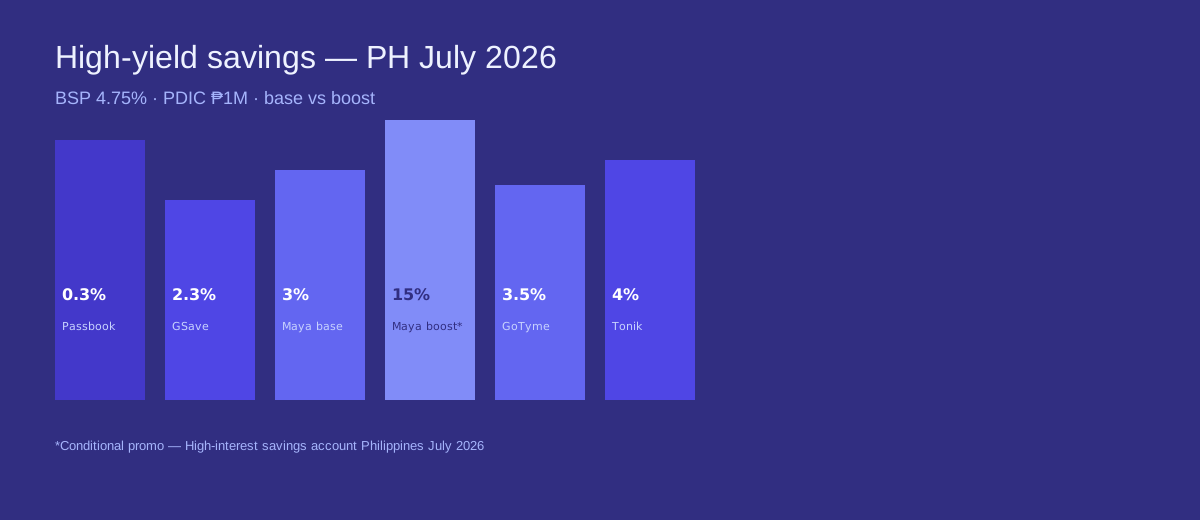
CIMB Bank operates via GCash CIMB GSave and UpSave. It offers tiered rates around 3–4% p.a. These rates depend on balance thresholds. Often, there is no maintaining balance required. CIMB is a popular choice for accessible high-yield savings.

ING Bank (Philippines) historically offered very high savings account rates. These were around 4% p.a. Current exact rates depend on ongoing promotions and balance tiers. ING remains a strong player in the digital banking space.

Maya Bank, formerly PayMaya, offers Maya Savings. This digital-bank product provides competitive promo rates. It requires no maintaining balance. Full mobile-app access makes it very convenient. Maya is quickly gaining popularity.

UNO Digital Bank offers high-yield savings. Interest rates are above 3% p.a. during some promo periods. The account is fully managed online. UNO provides a modern banking experience. It targets users who prefer digital solutions.

Other digital-style players include RCBC’s "high-interest savings" variants. Rizal Bank, UnionDigital, and Tonik also frequently run high-interest savings promos. These often range from 2–4% p.a. The digital banking landscape is very competitive. For the most accurate live list, check each bank’s website. Comparison sites like PeraMax.ph and RecommendCentral also update their listings monthly.

Updated overview - May 17, 2026

BankHigh-Interest ProductTypical Promo Rate (p.a.)Minimum Balance FeeNotes
BDO UnibankBDO Online Savings Plus0.65%₱300 if below ₱2,000Slightly lower, still requires online activity.
BPIBPI Maxi-Savers0.18%₱300 if below ₱3,000Rate continues to be low for standard variant.
MetrobankMetrobank One Savings (Digital)3.00%₱0Rate holds at 3.00% for digital users.
PNBPNB Easy Savings Plus0.40%₱200 if below ₱1,000Steady rate for conditional accounts.
Security BankSecurity Bank Money Builder2.95%₱1,000 (maintaining balance)Adjusted slightly, still competitive with balance.
3.00%
Highest Digital Bank Rate
0.65%
Highest Traditional Bank Promo
2
Digital Accounts with ₱0 MB

As of May 17, 2026, Metrobank One Savings maintains a strong 3.00% p.a. rate. This makes it a leading choice for digital savers. The absence of a maintaining balance fee remains a significant advantage. This offers flexibility and ease of use for customers.

Security Bank's Money Builder is slightly lower at 2.95% p.a. It requires a ₱1,000 maintaining balance. This distinction is crucial for savers comparing options. Traditional banks like BDO and BPI continue to offer much lower rates. Their focus remains on broader service offerings rather than just high yields.

The market indicates a stable environment for digital high-interest savings. Rates are generally holding firm. Savers should prioritize accounts that align with their balance capabilities. They should also consider their preference for digital versus traditional banking. Always check the fine print for any changes.

3. Eligibility, Requirements, and General Process

Eligibility for these accounts is typically straightforward. You must be a Filipino resident or an OFW. Valid Philippine ID and TOR/TIN are often required if applicable. Most banks require you to be 18 years or older. Some digital banks allow minors through linked guardian accounts.

General requirements include at least one primary valid ID. Some banks may ask for two. Proof of address might be needed. This could be a utility bill or a bank statement. Initial deposit amounts vary. They can range from ₱0 to ₱2,000. An email address and mobile number are essential for verification and OTPs.

The overall process is usually simple. First, choose a bank and product. Examples include CIMB GSave, ING Savings, or UNO Savings. Next, download the bank’s app or visit their website. Start the online account opening process. You will upload your ID and other documents. Complete the KYC (Know Your Customer) process. This often involves a face-capture or selfie with your ID. Input your personal details, beneficiary, and other disclosures. Finally, set up an MPIN or password. Approval usually takes minutes to 1–2 days.

4. Interest Rates, Fees, and Terms Comparison (General Snapshot)

Exact rates change frequently. Below is a representative 2026-style snapshot. Always cross-check with each bank’s current promo flyer for the most up-to-date information. Rates are subject to change without prior notice.

Provider / product (examples)Typical promo / regular rate (p.a.)Minimum balance feesNotes
Traditional bank savings (BDO, BPI, Metrobank baseline)~0.1–0.5% p.a.Often ₱300–₱1,200 penalty if below maintaining balanceLow interest, standard savings.
BPI “Save-Up High” or similarAround 0.06–0.2% p.a. standard, sometimes higher with promosMay require ≥₱1,000 ADBTiered; some variants have insurance riders.
CIMB GSave / UpSave (app-based)Promo tiers c. 3–4% p.a., depending on balance bracketUsually ₱0 maintaining balancePopular for students and beginners.
ING SavingsUp to ~4% p.a. in prior promos; exact current rates depend on promoOften no maintaining balanceFully digital, app-managed.
Security Bank Money BuilderHigher than standard savings; may rise with higher balance or tenureSome variants require minimum balanceOften tied to monthly savings habit.
Maya Savings / UNO SavingsAround 3–4% p.a. in current promo periodsMost are no maintaining balanceMobile-bank focused, quick onboarding.

Key points to compare include the effective annual rate (APY). This is more important than just the "interest rate." Compounding frequency significantly impacts actual earnings. Also, consider balance tiers. Rates often change if your balance crosses certain thresholds, for example, ₱100,000.

Always check conditions for boosted rates. Some accounts offer higher interest only if you meet specific requirements. These might include monthly savings, bill payments, or e-banking activities. Understanding these conditions is crucial for maximizing your returns. Read the terms and conditions carefully before committing.

5. Step-by-Step Application Process (Digital-Bank Style)

This template fits most digital-bank high-interest savings accounts. Examples include CIMB, ING, UNO, Maya, and Rizal Digital. The process is designed for speed and convenience. It largely removes the need for physical branch visits.

Prepare Documents

Gather your primary ID. This could be an e-Gov, passport, or driver’s license. Proof of address may be required. Ensure you have an Android or iOS phone. It must be capable of installing the bank’s app. Having everything ready saves time.

Download the App or Visit Website

Install the specific bank’s app. For instance, CIMB PH, ING, UNO, Maya, Security Bank, or BPI. Alternatively, visit their official website. Most digital banks prioritize their mobile app for onboarding.

Start Account-Opening Flow

Select the "Open a savings account" option. Or choose "High-interest savings." The interface is usually intuitive. Follow the on-screen prompts carefully. This initiates your application process efficiently.

Fill in Personal Details

Provide your name, birth date, and address. Include your occupation and tax status. This is necessary for Philippine tax compliance. Accuracy here is vital for smooth processing. Double-check all information before proceeding.

Upload ID and Take Selfie

Take clear photos of your primary ID. The app will then guide you to take a live selfie. This is a Bangko Sentral ng Pilipinas (BSP) KYC requirement. Ensure good lighting and a steady hand for clear images.

Set Up MPIN/Password

Choose a secure MPIN or password. If offered, set up two-factor authentication (2FA). This adds an extra layer of security. Strong credentials protect your account from unauthorized access.

Wait for Approval

Approval typically occurs within minutes. Some cases might take up to one business day. You will receive an SMS or email notification. This confirms when your account is active and ready for use.

Fund the Account

Transfer funds from another bank. Use services like InstaPay or PESONet. You can also transfer via GCash or PayMaya if linked. This final step makes your high-interest savings account operational. You can then start earning interest.

Monitor your interest and balance using the app. You can view accrued interest and transaction history. Traditional banks may require an in-branch visit for first-time account opening. However, many now allow fully online onboarding for returning customers. This hybrid approach offers flexibility.

Expert analysis - May 17, 2026

The current stability in high-interest savings rates suggests a mature market for digital products. Digital banks have largely found their competitive sweet spot. They continue to offer rates significantly above traditional counterparts. This trend is expected to persist as more Filipinos adopt digital banking.

Traditional banks are likely to maintain their current strategies. They cater to customers who value branch access and a wider range of services. Their high-yield variants often target specific customer segments or promotions. These are not always designed for broad appeal based on interest rates alone.

When selecting an account, savers should consider their financial goals. For emergency funds, liquidity and no maintaining balance are paramount. For slightly longer-term savings, a conditional higher rate might be acceptable. Always ensure your chosen account supports your financial objectives.

Important
Understand the difference between gross and net interest. Some banks might quote gross rates before taxes or fees. Always aim for the highest net return.
Digital Bank Average Rate
2.98% p.a.
Traditional Bank Average Promo Rate
0.41% p.a.
Rate Stability
High

6. Required Documents and Procedures (Philippine Context)

Typical documents requested by Philippine banks ensure proper identification. Having these ready will streamline your application. Always prepare original documents for presentation if needed.

Primary ID (one of the following):

  • Passport
  • Driver’s license
  • UMID (Unified Multi-Purpose ID)
  • SSS/GSIS ID
  • PRC license (Professional Regulation Commission)
  • Voter’s ID

These IDs are universally accepted across most financial institutions. Ensure your chosen ID is valid and not expired. The information must match your application details precisely.

Proof of address (if required):

  • Recent utility bill (electricity, water, PLDT)
  • Bank statement
  • Government-issued document showing address

Proof of address verifies your residential information. The document should be recent, usually within the last three months. Digital copies may be accepted by some online banks.

For Filipino residents:

  • TIN (Taxpayer Identification Number) from BIR
  • TOR (Taxpayer's Official Receipt) if employed

These documents are essential for tax compliance. They ensure your account follows Philippine regulations. Having them ready avoids delays in account opening.

For OFWs (Overseas Filipino Workers):

  • OFW ID or emigration document plus passport
  • Sometimes additional proof of overseas employment

OFWs have specific requirements due to their overseas status. These documents confirm their eligibility. They also help the bank comply with anti-money laundering regulations.

Procedures overview:

Online (digital banks): Upload ID and selfie. A KYC check follows. Upon approval, your account becomes active. This process is often completed within minutes or hours. It offers maximum convenience.

In-branch (BDO, BPI, Metrobank, PNB, etc.): Visit a branch location. Fill out the application form. Submit your ID and other required documents. A counter-agent will verify your details. Your account will then be activated. This traditional method is still common.

Hybrid (e.g., start online, finish at branch): Some banks allow you to begin online. However, they may require a short branch visit. This visit could be for biometrics or document verification. This combines digital convenience with physical security checks.

7. Advantages, Risks, and Important Considerations

Advantages:

Advantages

  • Higher interest than regular savings (2–4% p.a. vs. 0.1–0.5% p.a.).
  • Liquidity: You can withdraw anytime (no fixed maturity like time deposits).
  • Low or no fees: Many products have no maintaining balance and no monthly charges.
  • Tax-free treatment: Interest on peso-denominated savings deposits is generally exempt from tax under Philippine law.

Disadvantages

  • Rate volatility: Promo rates can drop or expire.
  • Account-specific conditions: Reduced interest if conditions are not met.
  • Digital-only limitations: Limited physical branch or ATM access.
  • Rates still below BSP policy rate / T-bill proxy.

These advantages make high-interest savings accounts attractive. They offer better returns for your accessible funds. The flexibility to withdraw anytime is a significant benefit. Reduced fees also contribute to overall savings. The tax-free nature of interest further boosts your earnings.

Risks and considerations:

Rate volatility is a key risk. Promotional rates can expire or decrease. Banks might revert to much lower standard rates. Always be aware of the terms. Account-specific conditions are another factor. Some high-yield accounts reduce or cancel extra interest. This happens if you do not meet monthly savings, usage, or balance requirements. Read the fine print carefully.

Digital-only limitations exist for some products. There might be no physical branch or limited ATM access. Interbank fees may apply for transfers. Also, the rate is still below the BSP overnight rate or T-bill proxy. As of 2026, the BSP policy rate is around 5–6%. High-interest savings often pay 2–4% p.a. Treasury bills (T-bills) can yield 3–6% p.a. However, T-bills have fixed maturity and primary-market access complexity.

Practical considerations include treating high-interest savings as emergency funds. They are also suitable for short-term savings. They are not ideal for long-term wealth-building. Diversify your funds. Keep at least up to ₱500,000 per bank covered under PDIC insurance. Consider splitting large amounts across multiple banks for added safety. This strategy protects your capital while maximizing interest.

8. BSP Regulations, PDIC Coverage, and Market Trends

BSP and PDIC coverage:

High-interest savings accounts are fully regulated by the Bangko Sentral ng Pilipinas (BSP). They fall under the same PDIC coverage rules as other peso-denominated deposits. This ensures consumer protection. PDIC covers up to ₱500,000 per depositor per bank. This coverage combines all deposit products. These include savings, current, and time deposits within that specific bank. This provides a safety net for your funds.

Regulatory context:

The BSP has actively encouraged digital-bank growth. This policy has led to many neobanks offering 2–4% p.a. high-yield savings. The BSP's policy rate (overnight rate) in 2026 is higher. It exceeds the interest paid by many savings accounts. Banks maintain a margin between their lending and deposit rates. This practice is standard in the banking industry.

Market trends (2025–2026):

Digital banks dominate the high-interest savings market. Most best-rate accounts come from platforms like Maya, UNO, and CIMB. These digital players leverage lower operating costs. They pass on savings through higher interest rates. This trend is expected to continue. Promo-driven yields are also common. Rates often spike during year-end promotions or new-product launches. They may then revert to standard levels. Savers should watch for these limited-time offers. They provide excellent opportunities for maximizing returns. Staying informed about these trends helps in making better financial decisions.

Share this article

Frequently Asked Questions about High Interest Savings Account Philippines

A High-Interest Savings Account in the Philippines is a type of bank account that offers significantly higher interest rates compared to traditional savings accounts. These accounts are designed to encourage saving by providing a better return on your deposited funds, often without the strict lock-in periods of time deposits.

The primary difference lies in the interest rate offered; HISAs typically provide rates ranging from 1% to 6% per annum, while regular savings accounts offer much lower rates, often below 0.5%. HISAs might also have specific requirements like maintaining a higher average daily balance or specific transaction conditions to qualify for the highest rates.

To open a HISA, you'll generally need at least two valid government-issued IDs, proof of address, and a minimum initial deposit. Some banks may also require a Tax Identification Number (TIN) and a minimum maintaining balance to avoid fees or to qualify for the advertised high interest rates.

Yes, HISAs offered by legitimate banks in the Philippines are safe, as they are regulated by the Bangko Sentral ng Pilipinas (BSP) and are insured by the Philippine Deposit Insurance Corporation (PDIC) up to P500,000 per depositor per bank. This provides a layer of protection for your deposited funds in case of bank failure.

The main advantage is earning significantly more interest on your savings, allowing your money to grow faster. HISAs also offer more liquidity than time deposits, as you can typically withdraw funds without penalty, making them suitable for emergency funds or short-to-medium term savings goals.

Some HISAs may have a higher minimum maintaining balance requirement or charge fees if the balance falls below it. Certain accounts might also impose transaction fees or require specific account activity to maximize interest earnings, so it's crucial to read the terms and conditions carefully.

Several banks, including digital banks and traditional banks, offer competitive HISAs. Popular options often include CIMB Bank, ING Philippines, Seabank, and Tonik Bank, which are known for their high interest rates and user-friendly digital platforms. Traditional banks like UnionBank and RCBC also have competitive offerings.

Interest on HISAs is typically calculated daily based on your average daily balance and is usually credited to your account monthly or quarterly. Some banks may tier their interest rates, meaning higher balances earn higher interest, so understanding the specific calculation method is important.

Yes, you can absolutely open multiple HISAs with different banks in the Philippines. This strategy allows you to diversify your savings and potentially take advantage of the best interest rates offered by various institutions, while also staying within PDIC insurance limits for each account.

When choosing a HISA, consider the interest rate, minimum initial deposit and maintaining balance, any associated fees, the ease of opening and managing the account, and the bank's reputation. Also, check if there are any conditions to earn the highest advertised rate, such as specific transaction requirements.

Related Articles

Philippine Business Credit: Rates, Banks & Regulations

This guide explores business credit options in the Philippines. It covers major banks, eligibility, application processes, and key regulations from the Bangko Sentral ng Pilipinas (BSP). Learn how to secure financing for your enterprise.

May 17, 2026

Bright Lending Philippines: Not Local, US-Based Loans

Bright Lending is a US-based online lender. This article clarifies that it has no presence or services in the Philippines. We explore local loan options, comparing terms, rates, and BSP regulations for Filipino borrowers.

May 14, 2026

Philippine Bridge Loans: Your Guide to Short-Term Funding

Discover how bridge loans work in the Philippines. This guide covers definitions, mechanics, major providers like BDO Unibank and BPI, eligibility, application processes, and crucial advantages and risks for these short-term financing options.

May 11, 2026

BPI Personal Loan Guide: Rates, Eligibility, & Comparison

The BPI Personal Loan offers an unsecured financing option from one of the Philippines' largest banks. This guide covers its mechanics, eligibility, interest rates, and how it compares to similar products from BDO Unibank, Metrobank, PNB, and Security Bank.

May 8, 2026