






The Philippine lending landscape presents a stark contrast between informal and formal financial services. Many Filipinos, especially those unbanked, often encounter "5-6" moneylending. This informal system, while readily accessible, carries significant risks.
Major Philippine banks, including BDO Unibank, BPI, Metrobank, PNB, and Security Bank, do not engage in "5-6" or similar unregulated practices. Instead, they offer structured and regulated personal loans. This guide aims to clarify the differences, pitfalls, and safer alternatives available.
What is 5-6 Lending?
5-6 lending describes an informal, high-interest loan arrangement common in the Philippines. Borrowers typically receive ₱5 and are expected to repay ₱6 within a short period, often 30 days. This translates to an effective monthly interest rate of approximately 20%.
These loans usually involve no collateral, no extensive paperwork, and quick disbursement. Lenders are often called "Bombay" operators, serving market vendors and small business owners. This scheme thrives due to its accessibility for those excluded from traditional banking services.
While prevalent, 5-6 lending is largely unregulated unless the lender registers under Republic Act 9474 (Lending Company Regulation Act of 2007). Formal banks, supervised by the Bangko Sentral ng Pilipinas (BSP), steer clear of this model. They instead offer personal loans with transparent terms and conditions.
Providers Offering Similar Services
A complete public list of pure 5-6 lenders does not exist due to their informal nature. Registered lending companies must comply with SEC and BSP rules. Major banks, however, provide formal personal loan products, which are regulated alternatives to informal lending.
These regulated personal loans cater to individuals needing funds for various purposes, from emergencies to home improvements. They offer competitive rates and secure borrowing options. Below is a comparative overview of personal loan products from several prominent banks and online lenders.
| Bank/Institution | Loan Product | Max Amount | Key Notes |
|---|---|---|---|
| BPI | Personal Loan | ₱3M | 0.99%-2% monthly add-on, flexible terms |
| PSBank | Personal Loan | ₱250K | 1.75% monthly add-on, 24-36 months payment |
| RCBC | Personal Loan | ₱5M | Up to 60 months, attractive promo fee waivers |
| Security Bank | Personal Loan | ₱2M | Competitive rates, various repayment options |
| UnionBank | Personal Loan | ₱2M | Fast processing, online application available |
| Maybank | Personal Loan | ₱1M | Convenient digital application, fixed monthly payments |
| Online Lenders (Tonik, TALA, Digido) | Quick Loans | ₱25K-125K | 4.8%-11.9% monthly effective interest, fast approval |
It is crucial to avoid informal 5-6 operators. They pose significant usury risks and lack regulatory oversight. Formal lenders, on the other hand, adhere to specific legal and ethical standards, protecting borrowers.
Formal alternatives — August 2026
BDO/BPI/Metrobank personal loans require disclosure, KYC and bureau update — slower but bounded cost versus daily collector pressure.
Registered lending companies under RA 9474 must show rates; still compare EIR against bank quote same week.
| Channel | Speed | Law | Big banks |
|---|---|---|---|
| 2–3 days | Bounded EIR | 5-6 | Same day |
| No contract | RA 9474 | SEC rules | If non-bank |
Confirm BSP-supervised lender status and disclosure-statement EIR before signing — policy-rate moves reprice new originations, not always existing fixed-rate blocks.
Eligibility and Requirements
For formal bank personal loans, specific criteria apply. Applicants must typically be Filipino citizens, aged between 21 and 65 years. A minimum annual income, often ranging from ₱360,000 to ₱500,000, is usually required.
Applicants must also demonstrate stable employment for at least one to two years. Self-employed individuals need to show business operations for two years or more. These requirements ensure the borrower's capacity to repay the loan.
In contrast, 5-6 lending often requires virtually no documentation. This ease of access can be deceptive, as it exposes borrowers to potential harassment and debt traps. Formal loan applications require standard documents to verify identity and financial standing.
Common required documents include valid government-issued IDs, such as UMID or PhilID. Payslips from the last three months, ITR/BIR Form 2316, and bank statements for the last six months are also typically requested. An employment certificate may also be necessary.
Interest Rates and Fees Comparison
The interest rates and fees vary significantly between informal 5-6 schemes and formal personal loans. 5-6 lending typically charges around 20% monthly interest, which translates to a staggering 240% Annual Percentage Rate (APR). Such rates are often illegal if they exceed BSP-mandated caps for regulated entities.
Formal personal loans from banks offer substantially lower and more transparent rates. While still varying, they are regulated and generally much more manageable. Fees for formal loans are also clearly disclosed, unlike the often hidden costs of informal lending.
| Provider | Monthly Rate (Add-on) | Effective APR (Approx.) | Fees | Term |
|---|---|---|---|---|
| PSBank | 1.75% | 30-40% | 1% processing fee | 24-36 months |
| RCBC | 1-2% | 20-35% | ₱2K-5K (waivable) | 12-60 months |
| Online Lenders (e.g., Kviku) | 4.8% | 60% | 0-10% processing | 1-6 months |
| BPI/Metrobank | 0.88-1.5% | 18-28% | 1-2% processing | 12-48 months |
| BDO Unibank | 1.0-1.7% | 20-32% | 1-2.5% processing | 12-36 months |
| PNB | 1.2-1.9% | 24-38% | 1-2% processing | 12-48 months |
| Security Bank | 1.0-1.8% | 20-35% | 1-2% processing | 12-36 months |
These rates are often tied to the BSP's overnight policy rate, which influences borrowing costs across the financial system. In 2026, the BSP overnight rate is projected to be around 5-6%, and Treasury bills (T-bills) hover around 3-5%. These benchmark rates affect the pricing of bank loans.
Always check the effective APR, not just the monthly add-on rate. The effective APR provides a more accurate picture of the total cost of borrowing. It includes all fees and charges, offering a true annual cost comparison.
Step-by-Step Application for Formal Loans
Applying for a formal personal loan involves a structured process. First, compare loan products from different banks like BPI, BDO, Metrobank, PNB, and Security Bank. Websites like Moneymax.ph can help compare various offers and check eligibility online.
Once a suitable product is identified, prepare all necessary documents. These include government IDs, proof of income, and bank statements. Ensure all documents are current and complete to avoid delays.
Submit your application either online or at a bank branch. Many banks offer online application portals for convenience. You may receive a tentative approval within one to two days, indicating preliminary eligibility.
Following tentative approval, submit the complete set of required documents. The bank will then conduct a thorough credit check, often through the Credit Information Corporation (CIC). This step assesses your creditworthiness.
Upon final approval, you will sign the loan contract and pay any applicable fees. This process typically takes one to five days. Funds are then credited to your designated bank account, often via InstaPay or PESONet for faster transfers.
Repayments are usually handled through auto-debit arrangements from your bank account. This ensures timely payments and helps maintain a good credit score. For 5-6 loans, the application is often verbal, with daily collections – a practice to be strictly avoided.
Required Documents
Securing a formal personal loan requires a standard set of documents. These verify your identity, income, and financial stability. Having these prepared beforehand can significantly expedite the application process.
Key documents include valid government-issued IDs, such as a PhilID or passport. Proof of income is crucial, typically consisting of payslips for employed individuals or BIR ITR (Income Tax Return) for self-employed applicants.
Bank statements, usually for the last six months, demonstrate your financial activity. An employment certificate or contract is also often required for employed borrowers. These documents confirm your current employment status and tenure.
For self-employed individuals, additional documents are necessary. These include DTI/SEC registration for the business and audited financial statements. These help banks assess the health and stability of the business.
Advantages, Risks, and Considerations
Formal loans offer numerous advantages over informal 5-6 schemes. Bank loans help build credit history, which is vital for future financial transactions. Deposits in quasi-banks are also insured by the Philippine Deposit Insurance Corporation (PDIC) up to ₱500,000, though this does not directly cover loans.
The primary risk of 5-6 lending is the debt trap. Its 20% monthly interest rate is astronomically high, especially compared to the BSP's typical cap of around 2-3% for regulated entities. Borrowers also face potential harassment and have no legal recourse against predatory practices.
Formal loans, while safer, also carry risks. These include the possibility of loan rejection, especially if credit scores are low. Foreclosure risks exist for collateralized loans, though personal loans are usually unsecured.
When considering a loan, borrow only what you truly need. Calculate the total payable amount using the BSP's loan calculator or similar tools. Given the current PHP inflation rate, hovering around 3-4%, preferring regulated banks over informal lenders is a prudent financial decision.
BSP Regulations and Updates
The Bangko Sentral ng Pilipinas (BSP) regulates the financial sector to protect consumers. BSP Circular 944 mandates truth-in-lending disclosures, ensuring transparency in loan terms. While no fixed usury cap exists post-1982, excessive interest rates can still be challenged under Civil Code Art. 1956.
Republic Act 9474 mandates that lending companies must register with the SEC and operate under specific rules. This legislation aims to formalize and regulate the lending industry, preventing exploitative practices. The BSP's oversight ensures fair collection practices and compliance with Anti-Money Laundering (AML) regulations.
Current trends for 2025-2026 indicate a rise in digital lending platforms like Tonik and Tala. The BSP overnight policy rate is expected to be around 5.25%, influencing bank interest rates. Treasury bills are projected at 4-6%, further affecting the cost of borrowing.
The PDIC specifically covers deposits, not loans. This means your savings are protected, but your loan obligations remain. The BSP continues to advocate for consumer protection and financial stability across all lending segments, although there are no specific "605" rules as it is not a recognized term.
Expert Tips for Borrowing
Always prioritize bank loans over informal 5-6 schemes. Utilize comparison platforms like Moneymax to find the best deals and promotional offers from BPI, BDO, Metrobank, PNB, and Security Bank. Comparing multiple options helps secure favorable terms.
Focus on the effective APR, not just the nominal monthly rate. Aim for an effective monthly rate below 2% to ensure affordability. This holistic view of costs prevents unexpected financial burdens.
Build your credit history responsibly by taking small loans and repaying them on time. Avoid submitting multiple loan applications simultaneously, as this can negatively impact your credit score, flagged by the Credit Information Corporation (CIC).
If you are an overseas Filipino, you might explore Philippine apps remotely. However, always verify local ties and regulatory compliance. Ensure the lending platform operates legally in both your current location and the Philippines.
Common Problems and Solutions
Loan rejection is a common problem, often due to low income or poor credit history. To address this, consider applying with a co-borrower or exploring online lenders with more flexible criteria. Improving your income and credit score over time will also help.
High fees can significantly increase the total cost of a loan. Always read the fine print and try to negotiate fee waivers, especially during promotional periods. Being proactive about understanding all charges can save you money.
Collection harassment, particularly from 5-6 lenders, is a serious concern. Report such incidents immediately to the Department of Trade and Industry (DTI) or the BSP hotline at 02-8708-7087. The BSP actively promotes fair debt collection practices.
Delayed loan payouts can be frustrating, especially during emergencies. Opt for digital lenders or banks that offer quick approval and disbursement, sometimes within an hour. Services like InstaPay and PESONet facilitate rapid fund transfers.
Over-indebtedness is a major challenge for many borrowers. If you find yourself struggling, consider debt management strategies like the debt snowball method. Government agencies like Pag-IBIG and SSS also offer relief programs and counseling services.
5-6 lending — July 2026
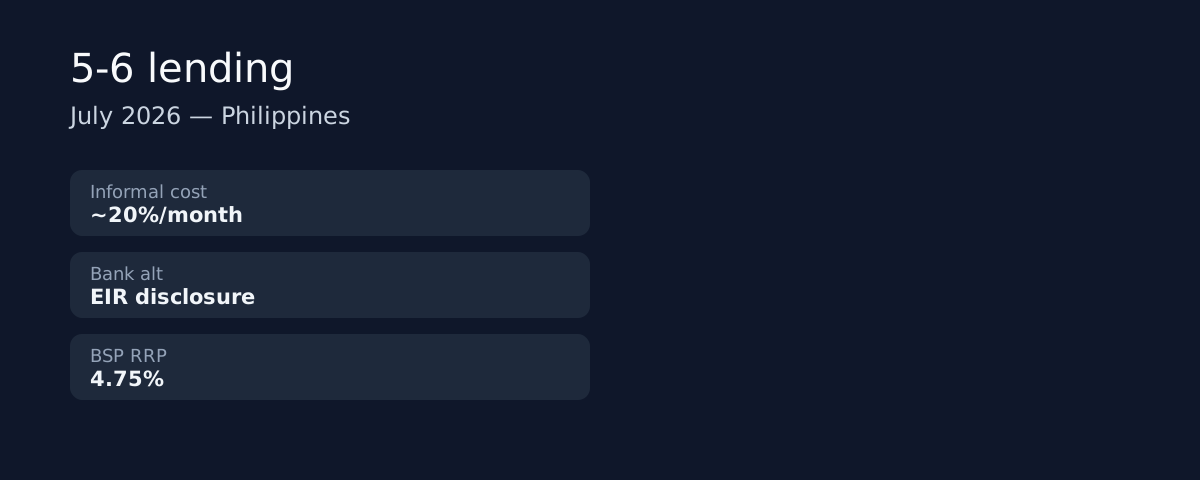
July 2026 reminder: informal 5-6 schemes (borrow ₱5, repay ₱6 in ~30 days ≈ 20% monthly) sit outside BSP consumer protections — major banks BDO, BPI, Metrobank, Security Bank do not offer this model. BSP Target RRP is 4.75% while system average bank lending was 10.89% in late June 2026 — still far below compounded 5-6 cost when rolled.
Formal alternative: regulated personal loan or microfinance with disclosure EIR, SEC/BSP oversight and bureau reporting. Even ₱20,000 ticket at ~15% EIR bank PL beats repeated 5-6 roll that doubles effective burden in months.
| Model | Typical cost | Regulation | July 2026 |
|---|---|---|---|
| 5-6 informal | ~20%/month | Often none | High risk |
| Bank PL | EIR ~12–30% | BSP-supervised | Disclosure |
| BSP RRP | 4.75% | Policy anchor | Not loan rate |
| Avg lending | 10.89% | System ref | Compare EIR |
Walk away from lenders demanding daily cash collection without contract — use BSP-supervised channels even if approval takes 2–3 days longer.
Before you borrow
Compare total peso cost (effective interest rate), not only monthly amortization — documentary stamps and insurance riders add to true cost.
Verify BSP-supervised lender on the disclosure statement; walk away from wallet or third-party payout schemes.
Match tenure to budget — do not stretch short-term needs over multi-year personal loans.
Check credit bureau record before applying; recent delinquencies block approval even on pre-approved offers.