






Understanding Assumable Mortgages in the Philippines
An assumable mortgage allows a new buyer to take over an existing home loan. The buyer inherits the seller's original loan terms. This includes the interest rate, outstanding balance, and repayment schedule. This option is particularly attractive in the Philippines given current high interest rates. The Bangko Sentral ng Pilipinas (BSP) policies influence these rates significantly.
This financial arrangement involves three primary parties. These are the seller (original borrower), the buyer (assumer), and the lender. The lender can be a bank or the Pag-IBIG Fund. The process requires a joint application to ensure the loan remains properly secured. The property's title deed serves as collateral for the mortgage.
The system works when a seller finds a buyer willing to assume the loan balance. The buyer first pays the seller's equity. This equity is the sale price minus the outstanding loan amount. The lender then evaluates the buyer's creditworthiness. If approved, the buyer makes direct payments to the lender. The property title officially transfers through a Deed of Absolute Sale. This transfer occurs only after the bank gives its consent.
Assumable mortgages are common for bank housing loans and Pag-IBIG loans. However, not all loans qualify for assumption. Fixed-rate loans from before recent BSP rate hikes are ideal candidates. These often carry rates between 6-8%. New loans in early 2026 might be priced at 8.5-11%.
Philippine Lenders and Their Assumption Policies
Major Philippine banks generally allow mortgage assumptions. However, their specific policies can vary significantly. No bank mandates assumption services. Each approval is handled on a case-by-case basis. This discretion aligns with BSP guidelines.
Several key providers in the Philippines offer assumable mortgage services. BDO Unibank is known for its flexible terms. It often allows repricing options. BPI Family Savings Bank typically offers fast processing times. Metrobank considers older loans for assumption. Security Bank frequently waives re-appraisal fees. Other banks like PNB, RCBC, China Bank, UnionBank, and PSBank also facilitate assumptions. PSBank tends to simplify the process for prime properties.
Government institutions like the Pag-IBIG Fund make assumptions common. This is outlined in their Circulars 428 and 439. Pag-IBIG loans usually have attractive rates, often between 6-8%. The Social Security System (SSS) also has internal rules for loan assumptions. Other banks like Bank of Commerce and Maybank may offer services, sometimes via home equity loans.
It is crucial to contact specific bank branches for their latest policies. The BSP's overnight rates, around 5.75% in March 2026, influence new loan rates. Treasury bill yields, typically 4-6%, also play a role. These rates affect the comparison between new and assumed loan terms.

Pag-IBIG pasalo — August 2026
Pag-IBIG assumptions follow Fund circulars — seller loan must be current, buyer passes income/age screen; joint application with release letter before title transfer.
Equity due to seller equals price minus outstanding balance — model in pesos including transfer tax and documentary stamps.
| Channel | Must show | Cash need | Pag-IBIG |
|---|---|---|---|
| Circular rules | Release letter | Bank | Case by case |
| Written OK | Equity | Upfront | Not financed |
Confirm BSP-supervised lender status and disclosure statement EIR before signing — policy-rate moves do not automatically reprice assumed legacy mortgages.
Eligibility and Documentary Requirements for Assumption
Buyers must meet strict lender standards to qualify for an assumable mortgage. Banks generally require a minimum monthly income of ₱50,000 or more. The buyer's age must be 65 or less at the loan's maturity. A clean credit history is also mandatory. Debt-to-income ratios should not exceed 40-50%. The buyer must be a Filipino citizen or a qualified foreigner with a valid BRP.
The seller's loan must be current with no arrears. The loan should also have at least five years remaining on its term. The property itself must be a bank-collateralized residential asset. This includes houses, lots, or condominium units. These criteria ensure the stability of the loan transfer.
Application Process Steps
The assumption process begins with negotiation between the buyer and seller. They must agree on the property price and the seller's equity. For example, a ₱5 million property might involve ₱2 million in equity. They also decide on splitting various fees. The buyer typically pays processing fees ranging from ₱3,000 to ₱150,000.
Next, a joint application is submitted to the lender. This package includes an assumption letter and other necessary documents. The lender then conducts a thorough review. This involves a credit check on the buyer and a property valuation. This review period usually takes one to two months.
Upon initial approval, the buyer pays the seller's equity. Various taxes also need to be handled at this stage. These include Capital Gains Tax (CGT) at 6% and Documentary Stamp Tax (DST) at 1.5%. Registration fees are also incurred. After full lender approval, assumption documents are issued. The property title is then annotated at the Registry of Deeds. The buyer can move in after the title transfer, even if some processing is still ongoing.
Required Documents for Joint Submission
A complete set of documents is critical for a smooth assumption process. The joint submission must include an assumption letter, following BSP formats. For the buyer, this means ITR/BIR Form 2316 for two years. They also need three months of payslips, a Certificate of Employment (COA), valid IDs, and a marriage certificate if applicable.
The seller must provide their latest loan statement and official receipts. The Original Certificate of Title (OCT) or Transfer Certificate of Title (TCT) is also required. Property documents include the TCT/OCT, tax declaration, and tax clearance. A location plan of the property is also needed. If a contract-to-sell exists, it must be included. Proof of equity payment is also a vital requirement.
Rates, Fees, and Terms: A Comparison
Assumed loan rates typically remain at their original levels. This means buyers can potentially secure rates of 6-8%, especially for Pag-IBIG loans. In contrast, new bank loans in early 2026 might range from 8.5-11%. This difference is heavily influenced by the BSP's policy rate, which is about 5.75%, and 91-day Treasury bill yields around 5.2%.
| Provider | Typical Assumed Rate | Fees (₱) | Max Term (Yrs) | Key Conditions |
|---|---|---|---|---|
| BDO Unibank | 7.0-9.0% (fixed) | 10,000-50,000 | 20-25 | Repricing option, top-up loan OK |
| BPI | 7.0-10.0% | 5,000-30,000 | Up to 20 | Fast processing, family bank focus |
| Metrobank | 7.5-9.5% | 20,000-100,000 | 20 | Older loans accepted, flexible |
| Security Bank | 7.0-9.0% | 10,000-50,000 | 20 | Often waives re-appraisal fees |
| PNB | 8.0-10.0% | 20,000-80,000 | 20 | Standard bank rules apply |
| Pag-IBIG | 6.0-8.0% | 3,000-10,000 | 30 | Exclusive to Pag-IBIG members |
New loans generally carry higher interest rates due to current market conditions. The Philippine Deposit Insurance Corporation (PDIC) insures bank deposits and loans up to ₱500,000. This insurance does not cover the principal amount of the loan itself, only the deposits related to it.
Advantages and Risks of Mortgage Assumption
Advantages
- Lower interest rates, potentially saving ₱100,000+ annually compared to new loans.
- Minimal processing fees for the buyer.
- No prepayment penalty for the seller.
- Faster move-in possible due to existing loan structure.
- Streamlined documentation compared to starting a new loan application.
Disadvantages
- Lender denial if the buyer's credit is poor.
- Potential top-up required if the property is revalued higher.
- Delays in title transfer, often taking 3-6 months.
- Risk of seller liens if equity is not paid promptly.
- Not all loans qualify, especially those with variable rates.
Buyers can save substantial amounts annually due to lower interest rates. Fees are also typically lower than for new loans. Sellers benefit from avoiding prepayment penalties. Buyers can often move into the property more quickly. However, several risks exist. The lender might deny the application if the buyer's credit is unsatisfactory. A revaluation could require the buyer to pay a "top-up" amount. Title delays can prolong the process for several months. Unpaid equity by the seller could also lead to liens on the property. It is wise to verify the loan has no arrears. Engaging a lawyer, costing ₱20,000-₱50,000, is highly recommended for all documentation.
Regulations, Trends, and Expert Advice
The Bangko Sentral ng Pilipinas (BSP) oversees all banking activities. This includes mortgage assumptions through the General Banking Law (RA 8791). There is no blanket ban on assumptions, but banks set their own specific rules. The PDIC covers bank loans, but not those from Pag-IBIG. Recent trends show rising popularity for assumptions after 2024 rate hikes. The BSP's overnight rate is 5.75%, with Treasury bills also increasing. The 2025-2026 market favors assumptions for sub-8% legacy loans. This is especially true given recent PHP volatility.
Pag-IBIG Fund Circulars 428 and 439 detail government rules for their loans. The Maceda Law (RA 6552) also offers protection for buyers assuming installment payments. This law protects buyers of real estate on installment payments.
Expert Tips for Assumable Mortgages
Potential buyers should actively search online platforms. Websites like OLX and Facebook Marketplace often list properties with "assume balance" offers. It is crucial to get pre-approval for the assumption. Buyers should also compare assumed rates against a new loan, which might be 8.5% or higher. Budgeting 2-5% of the sale price for fees and taxes is essential. For example, a ₱5 million property would require ₱100,000 to ₱250,000 for these costs. Pag-IBIG loans are generally the lowest-rate option if eligibility is met. Consulting a lawyer is mandatory for all legal aspects of the transaction.
Common Issues and Their Solutions
One common issue is loan denial for the buyer. This usually stems from poor credit or insufficient income. The solution is to improve credit scores or secure a co-borrower. Another frequent problem is title delays. These can be mitigated by parallel-processing the assumption with the bank's loan release. If the seller has arrears, they must pay these first. An escrow account can secure the equity payment. Revaluation hikes can lead to increased buyer costs. Negotiating a "no-top-up" clause in the agreement can prevent this. Finally, tax disputes can arise. Ensuring BIR clearance before application can resolve these issues proactively. Using services like InstaPay or PESONet for initial payments can ensure quick, traceable transactions, though large equity payments usually require bank transfers.
Assumable mortgage — July 2026
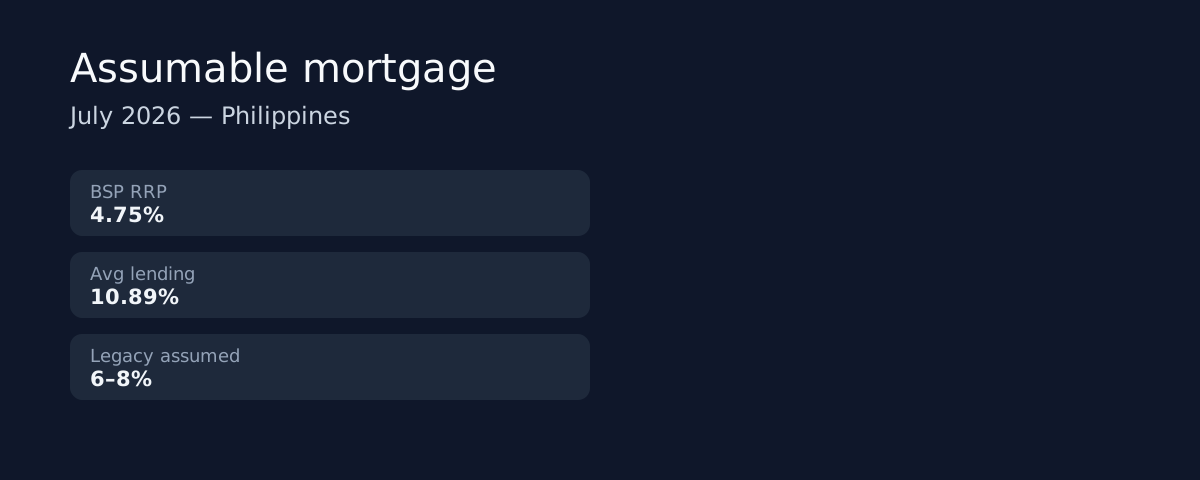
July 2026 check-in: taking over a seller's housing loan (pasalo/assumption) through BDO, BPI, Metrobank, Security Bank or Pag-IBIG still needs lender written consent — you inherit balance, rate and tenure, not automatic approval. BSP's Target RRP is 4.75% in July 2026 while system average bank lending rate was 10.89% in late June 2026 — legacy assumed loans at 6–8% can beat new origination priced off today's curve.
Buyer pays seller equity (sale price minus loan balance) upfront; bank re-underwrites income (often ₱50,000+/month), age cap and credit record. Pag-IBIG Circulars govern Fund assumptions separately from bank policies — get release letter before Deed of Absolute Sale.
| Benchmark | July 2026 | Assumption use |
|---|---|---|
| BSP Target RRP | 4.75% | Macro anchor |
| Avg bank lending | 10.89% | New loan reference |
| Legacy assumed | Often 6–8% | If repricing locked |
| Lender consent | Mandatory | Bank or Pag-IBIG |
Compare total peso cost (EIR + fees) versus fresh bank housing loan at current repricing — assumption saves only when legacy rate is materially below new-quote EIR and property title is clean.
Before you assume
Compare total peso cost (effective interest rate), not only monthly amortization — documentary stamps and insurance riders add to true cost.
Reject deals that skip lender written consent; legitimate assumption needs bank or Pag-IBIG approval on record.
Match tenure to budget — do not stretch short-term equity gaps with multi-year personal loans on top.
Check credit bureau record before applying; recent delinquencies block assumption even when seller loan is current.